Risk factors for redo procedures following ablation of accessory pathways in children. Multivariable analysis in a nationwide cohort study
EP Europace Journal


Abstract
The success rate for paediatric catheter ablation of accessory pathways (APs) is high in all but a minority of patients. Risk factors for recurrence of APs after first ablation have not been well identified yet.
The aim of our study was to determine risk factors for recurrence after primary AP ablation in the pediatric population.
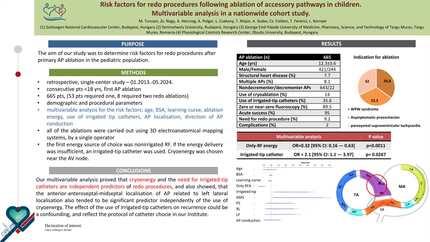
Our retrospective, single-centre, observational study included 665 consecutive patients (pts) who underwent AP catheter ablation for the first time between January 2013 and May 2024 at our Institution. 53 pts required one, and 8 pts two redo procedures. Demographic and procedural parameters were analyzed during the study. Risk factors such as age, body surface area (BSA), learning curve, ablation energy, use of irrigated-tip catheters, AP localisation and the direction of AP conduction were examined using multivariable analysis. All cases were carried out using 3D electroanatomical mapping systems. The choice of ablation energy and catheter type was based on the perator’s preference. The first energy source of choice was nonirrigated RF. If the energy delivery was insufficient, an irrigated-tip catheter was chosen. Cryoenergy was chosen near the AV node.
Mean age was 12.3±3,6 years (63,3% males). From 665 primary AP ablations, 633 (95%) were acutely successful. The indication for ablation was WPW-syndrome (34.8%), asymptomatic preexcitation (33.2%) and paroxysmal supraventricular tachycardia (32.2%). 7.7% of the pts had structural heart disease. Multiple APs occured in 8.1% of the pts. Nondecrementer APs dominated in 96.7% of cases. In 86% of the cases radiofrequency (RF) ablation was utilized, in the remaining cases cryoablation was used. Irrigated-tip catheters were used in 35.6% of the cases. 89.5% of the ablations were performed using zero or near-zero fluoroscopy. The complication rate of the procedures was 2%. During the study period 9.2% of the pts required redo procedures. Based on the multivariable analysis, the use of cryoenergy was an independent predictor of redo procedures, the sole use of RF energy significantly lowered the risk of redo ablations (OR=0.32 [95% CI: 0.16-0.63], p=0.0011). The use of irrigated tip catheters predicted the redo procedures (OR = 2,1 [95% CI: 1,1 — 3,97], p = 0,0267]), which reflect not only the ablation energy, but also the conditions that triggered the choice of irrigation. Age, BSA, learning curve, AP localisation and direction of AP conduction were not found to be significantly relevant, although antero-midseptal APs tended to have higher redo procedures.
Our multivariable analysis proved that cryoenergy and the need for irrigated-tip catheters are independent predictors of redo procedures, and also showed, that the anterior-anteroseptal-midseptal localisation of AP related to left lateral localisation also tended to be significant predictor independently of the use of cryoenergy.

You may be interested in