Impact of initial ablation parameters on pulmonary vein reconnection in redo high-power short-duration catheter ablation for atrial fibrillation
EP Europace Journal


Abstract
Pulmonary vein isolation (PVI) is the cornerstone for catheter ablation (CA) of atrial fibrillation (AF). Although acute electrical PVI is common during AF ablation, a key challenge in assessing long-term outcomes lays in the variable and non-predictable nature of lesion durability after ablation. Electrical reconnection of pulmonary veins (PV) following initial isolation is the most common trigger for AF recurrence, highlighting the limitations of current ablation strategies in achieving long-term success. Recently, high-power short-duration (HPSD) CA has emerged as an alternative to conventional standard-power long-duration ablation. Several studies have demonstrated that HPSD CA increased first-pass PVI and freedom from atrial arrhythmia, while also reducing procedural times and improving patient tolerability. However, there is currently limited data regarding the impact of previous ablation parameters and different ablation strategies in redo procedures following HPSD CA for AF.
To investigate the impact of previous ablation parameters and ablation strategies on the outcomes of redo procedures following HPSD CA for AF.
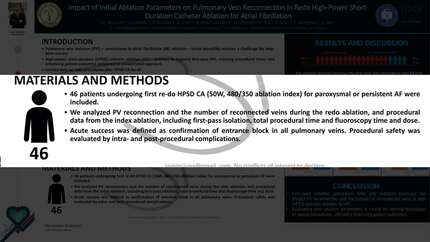
We included patients with paroxysmal or persistent AF who underwent first redo HPSD CA using a contact-force sensing catheter. We analyzed PV reconnection and the number of reconnected veins during the redo ablation, and procedural data from the index ablation, including first-pass isolation, total procedural time and fluoroscopy time and dose. Acute success was defined as confirmation of entrance block in all pulmonary veins. Procedural safety was evaluated by intra- and post-procedural complications.
A total number of 46 patients were included in the study (mean age 58 ± 6 years; 43.5% male; 56.5% female). The median interval between the first and redo procedures was 22 ±14 months. Reconnection of at least one PV was documented in 38 patients (82.61%) and the mean number of reconnected PVs was 2.0 ± 1.1. Patients with PV reconnection during the redo ablation had a lower first-pass isolation rate (p=0.05), longer total procedure time (260.0 ± 84.8 vs. 207.5 ± 64.6 min, p=0.003), and lower radiation exposure (26.9 ± 19.1 vs. 56.8 ± 1.9 min, p<0.001 and 4373.9 ± 3532.4 vs. 12542.1 ± 241.9 μGy, p=0.022). Additionally, these parameters were positively correlated with a higher number of reconnected veins. Acute success was achieved in 100% of patients, with no significant complications observed.
Our data suggests that initial procedure parameters, including first-pass isolation, procedural time and radiation exposure may serve as predictors for PV reconnection and the number of reconnected PVs during redo HPSD CA for AF. The findings highlight the importance of assessing prior ablation parameters and refining ablation strategies in redo procedures to optimize outcomes.

You may be interested in