Safety and efficacy of irrigated flex-tip catheters in AVNRT using 3D electroanatomical mapping
EP Europace Journal


Abstract
Transcatheter ablation is the standard treatment for atrioventricular (AV) nodal re-entrant tachycardia (AVNRT). Studies of irrigated flexible-tip catheters’ (IFTC) use in this substrate are scarce, highlighting the need for further research. The aim of our study is to demonstrate the efficacy and safety of using IFTC in AVNRT using 3D anatomical mapping (3D-AM).
Descriptive analysis of consecutive patients undergoing AVNRT ablation between October/21-May/24.
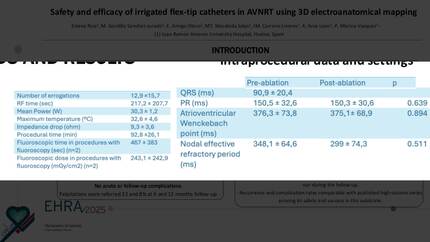
We analyzed 61 patients referred for AVNRT ablation (90.2% 1st procedure, 9.8% 2nd), 29% male, mean age 52.5±14.9 years. 100% were in sinus rhythm at the moment of the procedure, 5.8% were on antiarrhythmic drugs (3 betablockers, 1 propafenone, 1 amiodarone and 1 flecainide). ECG findings and electrophysiological study parameters previous and after the ablation are sumarized in Table 1, highlighting no significative change in the PR interval, AV Wenckebach point and nodal effective refractory period.
AVNRT was inducible in 96.7%, although 62.3% needed isoproterenol infusion. A jump in AV conduction was observed in 93.4%. Typical AVNRT was the most frequently induced (91.8%), whereas slow-slow and fast-slow AVNRT were less frequent (3.3% each). We were able to recognize slow path potentials in 16.3% of our patients, but the ablation approach was anatomical using 3D-AM with zero fluoroscopy objective, a decapolar coronary sinus catheter and an IFTC (17mL/min irrigation speed). Ablation parameters are summarized in Table 2. Two patients required fluoroscopy for procedural safety: one had a His bundle pacing pacemaker (PM) and another a coronary sinus diverticulum.
During ablation, 93.4% developed slow junctional beats. Acute success (non-inducibility) was reached in 100% but 54% still had dual AV node physiology. Isoproterenol infusion after ablation was used in 82% of the procedures. In 4 patients cavotricuspid isthmus ablation for atrial common flutter was added. No intraprocedural complications were registered, no AV block or lengthening in the PR interval. Two patients had a PM implantation for symptomatic sinus node dysfunction known before the procedure (time to implant 32 ± 43.8 days).
Mean follow-up was 9 [5-12] months. Two recurrences were registered, both the day after the procedure. Symptomatic palpitations without documentation of tachyarrhythmias were frequent but reduced during follow-up (22.9% at 3, 12.5% at 6 and 7.7% at 12-months follow-ups). No deaths of cardiovascular hospitalization or access to emergency room were registered during follow-up.
Patients who underwent ablation for AVNRT using IFTC and 3D-AM demonstrated a success rate of 100% with no AV block or lengthening in the PR interval neither during the procedure nor during the follow-up, with recurrence and complication rates comparable with published high-volume series, proving its safety and success in this substrate.
Contributors

M T Moraleda Salas
Author
J M Carreno Lineros
Author
A Arce Leon
Author
P Morina Vazquez
Author
I Esteve Ruiz
Author
M Gordillo Sanchez-Jurado
Author
E Amigo Otero
Author
You may be interested in