Sustained cardioneuroablation success with optimized CARTO3 mapping assessed through continuous loop recorder monitoring: insights from a single-center experience
EP Europace Journal


Abstract
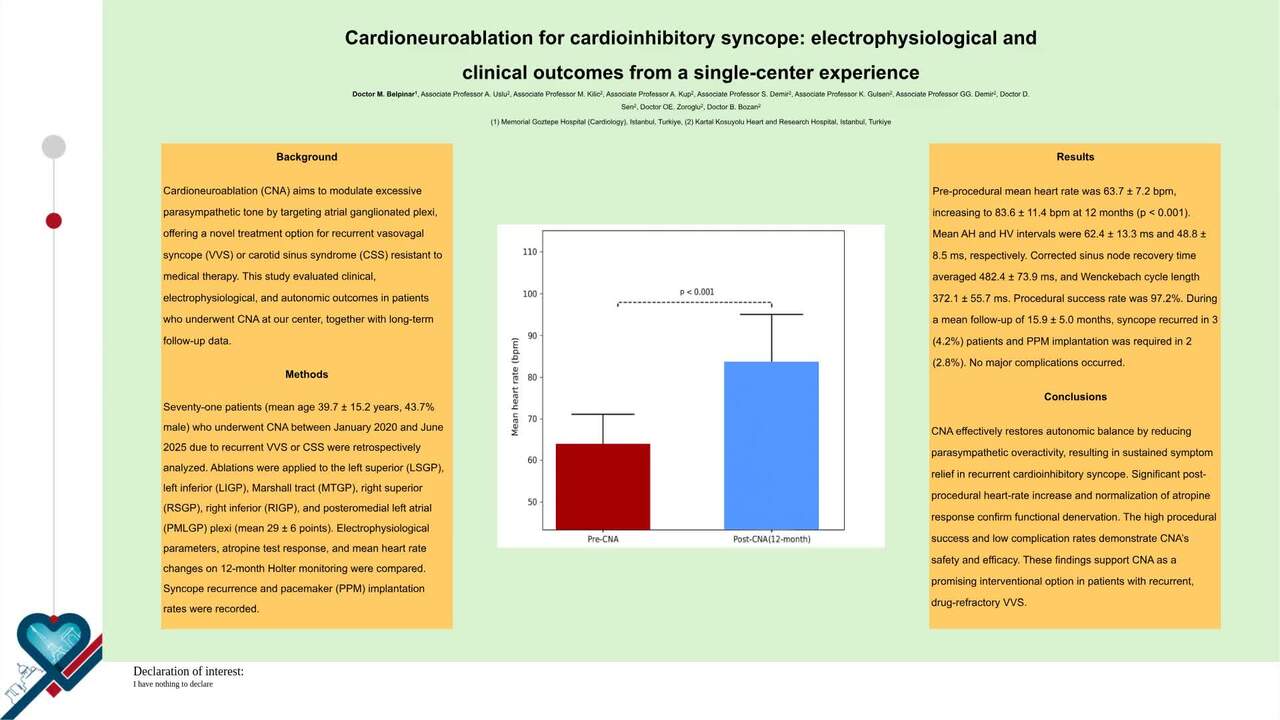
Cardioneuroablation (CNA) is a promising intervention for managing autonomically-mediated bradyarrhythmias and vasovagal syncope, aiming to reduce the need for permanent pacemaker implantation. The procedure involves targeted ablation of ganglionated plexi (GP) to modulate vagal hyperactivity, although variability in workflow and mapping techniques can influence its consistency and efficacy.
This study aimed to refine the CNA protocl through an optimized workflow using the CARTO3 mapping system. By integrating fractionated electrogram analysis, we sought to achieve more precise GP targeting and evaluate its impact on clinical outcomes through continuous loop recorder monitoring.
We conducted a 12-month follow-up study involving 15 patients (mean age 50.8 years, SD = 17.1; range 26–77) with history of syncope. Primary procedural indications included sick sinus syndrome (60%), brady-tachy syndrome (33.3%), and type II atrioventricular block (6.7%). To optimize GP targeting, we used the CARTO3 mapping system with ablation and mapping catheters to create electroanatomical models. Left atrial access was achieved via transseptal puncture, and complex atrial fractionated electrograms (CFAE) software identified target signals with more than 3 deflections, each lasting at least 2 milliseconds and with amplitudes above 0.06 millivolts. Duration intervals ranged from 2 to 140 milliseconds, prioritizing areas with high deflection counts in specific GP clusters. The ablation sequence began in the right atrium and in 11 patients progressed to the left (bi-atrial approach), with gradual heart rate (HR) increases observed. All patients were monitored using implantable loop recorders.
The protocol led to significant HR improvement at multiple follow-up intervals, with a sustained increase at 12 months (p = 0.009). Syncope recurrence was low, with only 13.3% of patients (2 cases) requiring pacemaker implantation due to symptomatic events, reflecting a 95% reduction in syncopal burden. No other peri-procedural or post-procedural complications occurred. Heart rate changes remained significant across all follow-up points (1, 3, 6, and 12 months, p < 0.01), underscoring the procedure’s long-term effect. Further analysis showed no significant difference in HR variability between bi-atrial approach and right atrial ablation, and predictors like atrial fibrosis, gender, and syncope history did not influence long-term HR changes.
This refined CNA protocol demonstrated lasting HR stabilization and reduced syncope recurrence at 12 months, with significant improvements maintained throughout follow-up via implantable loop recorder monitoring. Our single-center experience using the CARTO3 system shows that this optimized, "non-visual" workflow can be safe and effective and may be a promising alternative to device implantation in well-selected patients.
Contributors

L Donisi
Author
M Saviano
Author
F Toriello
Author
G Mallardi
Author
F Valli
Author
A V Pollina
Author
V Borrelli
Author
S Carugo
Author
You may be interested in