Fluoroless catheter ablation of leftsided tachycardias in patients with cardiac implantable electronic devices: a single-centre retrospective study
EP Europace Journal


Abstract
The use of intracardiac echocardiography (ICE) and 3-D electroanatomical mapping (3-D EAM) systems allows safe fluoroless catheter ablations (CAs) in nearly all types of arrhythmias. Nevertheless, for patients with cardiac implantable electronic devices (CIEDs) there exists a notable paucity of data concerning the rate of leads’ dislocation in fluoroless procedures.
The aim of this single-centre retrospective study was to evaluate the rate of leads’ dislocation in fluoroless CA of arrhythmias necessitating left sided approach in patients with CIEDs.
We performed a retrospective study in patients with CIED who underwent fluoroless CA with transseptal puncture (TSP) for any arrhythmia between February 2016 and November 2023. All procedures were performed without fluoroscopy, guided by a 3-D EAM system and ICE. The leads were repeatedly visualized with ICE during introduction of catheters, their manipulation, TSP and ablation. The device´s parameters were tested before and after the procedure.
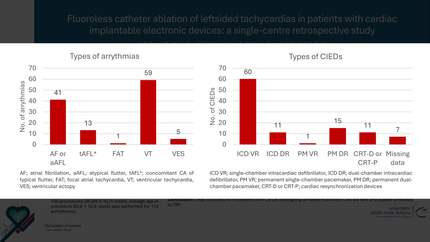
Our study included 88 patients. A total of 105 procedures (90 [86.5 %] in males, average age at procedure 65.6 ± 10.6 years) was performed for 119 arrhythmias; there were 41 (39.4 %) CAs of atrial fibrillation or atypical flutter and 13 (12.5%) concomitant ablations of typical flutter, 1 (1.0 %) ablation of focal atrial tachycardia, 59 (56.7 %) of ventricular tachycardia and 5 (4.8 %) of ventricular ectopy. 60 patients (56.7 %) had single-chamber intracardiac defibrillator (ICD VR), 11 patients (10.6 %) had dual-chamber intracardiac defibrillator (ICD DR), 1 patient (1.0 %) had permanent single-chamber pacemaker, 15 patients (14.4 %) had permanent dual-chamber pacemaker, and 11 patients (10.6 %) had cardiac resynchronization devices (CRT-D or CRT-P). For 7 patients (6.7 %) the retrospective data about device’s type is missing.
In two procedures (2/106, 1.9 %) we observed ventricular lead dislocation while there were no atrial lead dislocations. One ventricular lead dislocation happened in CA of atypical flutter in a patient with ICD DR during manoeuvring of catheters in the right heart chambers. The other ventricular lead dislocated in a patient with ICD VR who experienced coronary air embolism during CA of ischemic ventricular tachycardia necessitating cardiopulmonary resuscitation with chest compressions. According to ICE imaging the lead dislocation happened after the successful resuscitation, therefore it was not related to fluoroless ablation method. Both lead dislocations required subsequent lead repositioning. There were no lead dislocations related to the TSP and the process of obtaining transseptal approach. In other patients, the device interrogation after completion of procedures showed no change in parameters.
Lead dislocations in patients with CIEDs undergoing leftsided fluoroless CAs are rare and appear unrelated to TSP.
Contributors

V Podlogar
Author
M Jan
Author
A Pernat
Author
T Prolic Kalinsek
Author
B Antolic
Author
L Klemen
Author
M Rauber
Author
D Zizek
Author
You may be interested in