Efficacy and safety of morphine during thermal catheter ablation of atrial fibrillation
EP Europace Journal


Abstract
Approaches to sedation for atrial fibrillation (AF) ablation range from conscious or deep sedation to general anesthesia. Additionally, legislation concerning the use of sedatives and anesthetic drugs differs across countries and only a minority of the EP Lab has the possibility to have an anaesthesiologist always available. In this scenario the possibility to perform AF ablation with a less painful approach without the necessity to rely on the call for an anaesthesiologist seems to be an advantage for the majority of EP Labs.
Evaluate the impact of the use of morphine as first anasthetic drug during AF ablation procedure.
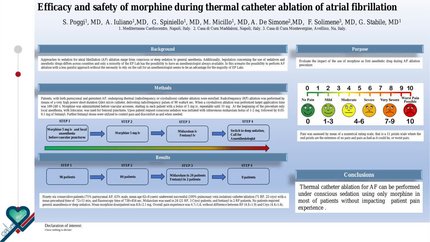
Patients, with both paroxysmal and persistent AF, undergoing thermal (radiofrequency or cryoballoon) catheter ablation were enrolled. Radiofrequency (RF) ablation was performed by means of a very high power short duration Qdot micro catheter, delivering radiofrequency pulses of 90 watts/4 sec. When a cryoballoon ablation was performed target application time was 180-240 s. Morphine was administrated before vascular accesses, starting in each patient with a bolus of 5 mg iv, repeatable until 10 mg. At the beginning of the procedure only local anesthesia, with lidocaine, was used for femoral punctures. Upon patient request conscious sedation was initiated with intravenous midazolam bolus of 1-2 mg, followed by 0.05-0.1 mg of fentanyl. Further fentanyl doses were utilized to control pain and discomfort as and when needed. Pain was assessed by mean of a numerical rating scale, that is a 11 points scale where the end points are the extremes of no pain and pain as bad as it could be, or worst pain.
Ninety-six consecutive patients (71% paroxysmal AF, 63% male, mean age 62±8 yaers) underwent successful (100% pulmonary vein isolation) catheter ablation (71 RF, 25 cryo) with a mean procedural time of 72±11 min, and fluoroscopy time of 738±454 sec. Midazolam was used in 24 (21 RF, 3 Cryo) patients, and fentanyl in 2 RF patients. No patients required general anaesthesia or deep sedation. Mean morphine dose/patient was 8.8±2.1 mg. Overall pain experience was 4.7±1.6, without difference between RF (4.8±1.9) and Cryo (4.4±1.6).
Thermal catheter ablation for AF can be performed under conscious sedation using only morphine in most of patients without impacting patient pain experience .
Contributors

S Poggi
Author
A Iuliano
Author
G Spiniello
Author
M Micillo
Author
A De Simone
Author
F Solimene
Author
G Stabile
Author
You may be interested in