Epicardial adipose tissue interference in atrial fibrillation (AF) ablation depending on energy sources: high power short duration vs. Pulsed Field energy
EP Europace Journal


Abstract
Preclinical studies have shown mixed results regarding the influence of adipose tissue on effective pulsed field ablation (PFA) energy delivery, raising questions about its efficacy in patients with elevated levels of epicardial adipose tissue (EAT).
We hypothesized that elevated EAT levels may be linked to higher AF recurrence rates, when using PFAcompared to Radiofrequency ablation (RF).
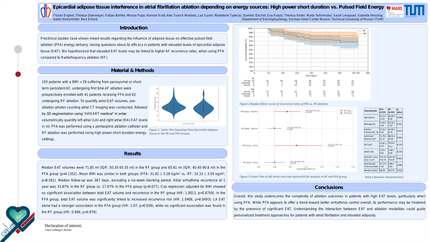
We aimed to investigate the influence of EAT volumes on AF recurrences after PVI, comparing of PFA and RF energy in patients suffering from paroxysmal AF with a BMI > 29kg/m².
103 patients with a BMI > 29 suffering from paroxysmal or short-term persistent AF, undergoing first time AF ablation were prospectively enrolled with 41 patients receiving PFA and 62 undergoing RF ablation. To quantify atrial EAT volumes, pre-ablation photon counting atrial CT imaging was conducted, followed by 3D segmentation using "inHeart medical" in order volumetrically quantify left atrial (LA) and right atrial (RA) EAT levels in ml. PFA was performed using a pentaspline ablation catheter and RF ablation was performed using high power short duration energy settings.
Median total EAT volumes were 71.85 ml(IQR: 50.35-93.35 ml) in the RF group and 65.61 ml (IQR 40.45-90.8 ml) in the PFA group (p=0.1352). In the PFA group the mean BMI was 31.92 ± 3.28 kg/m², vs. 32.33 ± 3.59 kg/m² in the RF group, with no significant difference between groups (p=0.561). The median follow-up was 367 days (IQR:335-498 days), excluding a six-week blanking period. Recurrence of any atrial arrythmia after 1 year occurred in 33.87% in the RF group compared to 17.07% in the PFA group, although this difference was not statistically significant (log-rank test: p=0.077) (Figure 1). Cox regression analysis adjusted for BMI revealed thatin the RF cohort, totalEAT volume was not significantly associated with recurrence risk (HR: 1.0013, 95% CI: 0.9850-1.0179; p=0.8759). However, in the PFA group, total EAT volume was significantly associated with increased arrythmia recurrences (HR: 1.0406, 95% CI: 1.0001-1.0827; p=0.0493) resulting in a 4.06% increased recurrence risk per ml increase in the PFA group compared to 0.13% per ml increase in the RF group) (Figure 2). LA EAT alone revealed an even stronger association with outcomes in the PFA group (HR = 1.07, 95% CI: 1.004-1.151, p = 0.039), whilst no significant association was found In the RF group HR = 0.999, 95% CI: 0.969-1.031, p = 0.979).
PFA resulted in high rates of freedom from any atrial arrythmia recurrences after 1 year. However, our findings suggest that EAT may have a more significant impact on recurrences in PFA compared to RF ablation. These findings warrant further clinical and preclinical studies investigating the impact of EAT on PFA success. Cox regression LA EAT volumes
Contributors

F Englert
Author
F Bahlke
Author
M A Popa
Author
S Lengauer
Author
E Koops
Author
A Tunsch
Author
P Bicprendi
Author
H Krafft
Author
T Reiter
Author
G Hessling
Author
I Deisenhofer
Author
N Erhard
Author
You may be interested in