Determining the optimal electrogram signal annotation method to enhance functional Ventricular Tachycardia substrate identification with decremental evoked potential (DeEP) mapping
EP Europace Journal


Abstract
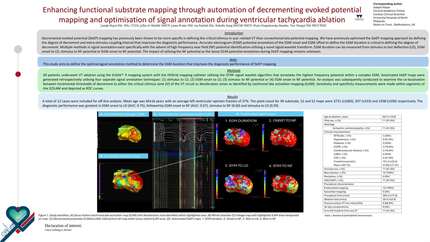
Decremental evoked potential (DeEP) mapping has previously been shown to be more specific in defining the critical isthmus in scar-related VT than conventional late potential mapping. The DeEP mapping approach has previously been optimised by defining the degree of decrement and extra-stimulus coupling interval that improves the diagnostic performance. Accurate electrogram (EGM) potential annotation of the EGM onset and EGM offset to define the EGM duration is critical in defining the degree of decrement. Multiple methods in signal annotation exist specifically with the advent of high frequency near field (NF) potential identification utilising a novel signal wavelet transform. EGM duration can be measured from stimulus to last deflection (LD), EGM onset to LD, stimulus to NF potential or EGM onset to NF potential. The impact of utilising the NF potential as the latest EGM potential annotation during DeEP mapping remains unknown.
This study aims to define the optimal signal annotation method to determine the EGM duration that improves the diagnostic performance of DeEP mapping.
All patients underwent VT ablation using the EnSite™ X mapping system with the HDGrid mapping catheter utilising the OTNF signal wavelet algorithm that annotates the highest frequency potential within a complex EGM. Automated DeEP maps were generated retrospectively utilising four separate signal annotation techniques: (1) stimulus to LD, (2) EGM onset to LD, (3) stimulus to NF potential or (4) EGM onset to NF potential. An analysis was subsequently conducted to examine the co-localisation between incremental thresholds of decrement to either the critical isthmus zone (IZ) of the VT circuit or deceleration zones as identified by isochronal late activation mapping (ILAM). Sensitivity and specificity measurements were made within segments of the IZ/ILAM and depicted as ROC curves.
A total of 12 cases were included for off-line analysis. Mean age was 66±16 years with an average left ventricular ejection fraction of 37%. The point count for SR substrate, S1 and S2 maps were 3731 (±1063), 937 (±333) and 1038 (±330) respectively. The diagnostic performance was greatest in EGM onset to LD (AUC: 0.75), followed by EGM onset to NF (AUC: 0.67), stimulus to NF (0.60) and stimulus to LD (0.59).
The diagnostic performance of DeEP mapping is improved by measuring EGM duration starting from the EGM onset as opposed to the stimulus artefact. EGM offset appears to be better defined by LD rather than the NF component however these observations require prospective testing using automated DeEP maps. Study workflow Baseline characteristics
Contributors

J Mayer
Author
J Al-Sheikhli
Author
M Niespialowska-Steuden
Author
I Patchett
Author
R Siang
Author
J Winter
Author
T Dhanjal
Author
You may be interested in