Ablation for idiopathic ventricular arrhythmias using focal pulsed field ablation
EP Europace Journal


Abstract
Catheter ablation is a feasible option for treatment of patients with high burden of monomorphic idiopathic premature ventricular complexes (PVCs) or with idiopathic ventricular tachycardia (VT) and may be considered as a first line treatment in selected patients. Pulsed field ablation (PFA) is a new type of nonthermal energy source delivered to the underlying tissue via the ablation catheter and used for ablation of arrhythmic substrates (1, 2).
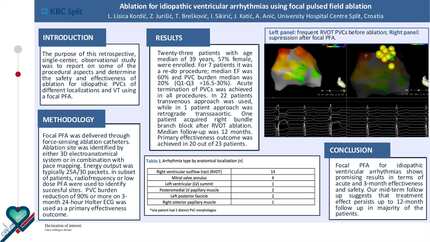
The purpose of this retrospective, single-center, observational study was to report on some of the procedural aspects and determine the safety and effectiveness of ablation for idiopathic PVCs of different localizations and VT using a focal PFA.
Procedures were performed in deep sedation for all patients. Focal PFA was delivered through a commercially available force-sensing ablation catheters. Ablation site was identified by either activation mapping using 3D electroanatomical system or in combination with pace mapping. Energy output was typically 25A/30 packets while in subset of patients, radiofrequency or low dose PFA were used to identify succesful sites. Number of applications was left to the operators discretion. Patient follow-up was scheduled 3 months after the ablation with mandatory 24-hour Holter ECG and follow up in clinic at 6 and 12 months after the procedure. PVC burden reduction of 90% or more on 3-month 24-hour Holter ECG was used as a primary effectiveness outcome.
Twenty three patients were enrolled (Table 1). Acute termination of PVCs was achieved in all procedures. Concomitant PFA and RF ablation was performed in 3 patients. In 22 patients transvenous (right ventricle, transseptal or coronary sinus) approach was used, while in 1 patient approach was retrograde transsaaortic. Anatomical arrhythmia localization is shown in Table 2. Two patients acquired left posterior hemiblock due to intended ablation of left posterior fascicle and one patient acquired right bundle branch block after RVOT ablation. Median follow-up was 12 months (Q1-Q3; 8-17 months). Primary effectiveness outcome was achieved in 20 out of 23 patients. During the follow-up period 3 patients additionally reported subjective symptoms of significant arrhythmia burden.
Focal PFA for idiopathic ventricular arrhythmias shows promising results in terms of acute and 3-month effectiveness and safety. Our mid-term follow up suggests that treatment effect persists up to 12-month follow up in majority of the patients. Larger studies are necessary to confirm these findings and to assess long-term outcomes of the procedure.
Contributors

L Lisica Kordic
Author
Z Jurisic
Author
T Breskovic
Author
I Sikiric
Author
J Katic
Author
A Anic
Author
You may be interested in