Pulsed-field ablation versus radiofrequency ablation in patients undergoing repeat catheter ablation for atrial fibrillation
EP Europace Journal


Abstract
Pulsed-field ablation (PFA) is non-inferior compared to thermal energy sources such as radiofrequency ablation (RFA) or cryoballoon ablation for de novo pulmonary vein isolation (PVI). However, its potential value for repeat catheter ablation (CA) following unsuccessful thermal PVI has not been assessed.
To compare the procedural characteristics, safety, and efficacy between PFA and RFA in patients undergoing repeat CA after prior thermal PVI.
Patients with recurrent atrial fibrillation (AF) undergoing repeat CA at a tertiary referral center were prospectively enrolled. All redo procedures were guided by a 3D electro-anatomical mapping system and performed using either PFA or RFA.
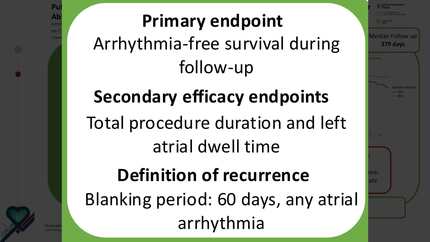
A total of 185 patients underwent repeat CA for AF (median age 68 [60-74] years, 31% female, 53% paroxysmal AF and 47% persistent AF). PFA was used in 71 patients (38%), while RFA was used in 114 patients (62%). The median procedure times was similar between the PFA and RFA groups: 61 [50-71] min vs. 56 [45-82] min (p=0.956), whereas fluoroscopic time was longer in the PFA group (8 [6-12] min vs. 4 [2-8] min, p<0.001). A total of 4 complications occurred, all in the RFA-group. Recurrence-free survival rates after repeat CA were 56% and 70% in the PFA vs. RFA-group after a median follow-up of 379 [225-603] days (pLog-rank=0.063). Posterior wall isolation was more commonly performed in the PFA group (72% vs.12%).
In patients undergoing repeat CA after thermal PVI, PFA resulted in similar procedural characteristics, safety, and arrythmia-free survival compared to RFA.
Contributors

G Di Bari
Author
C I Isenegger
Author
A R Arnet
Author
F J Jordan
Author
D S Spreen
Author
B S Subin
Author
P K Krisai
Author
S K Knecht
Author
N S Schaerli
Author
G V Voellmin
Author
F M Mahfoud
Author
C S Sticherling
Author
M K Kuehne
Author
P B Badertscher
Author
You may be interested in