Atrial contraction recovery in persistent atrial fibrillation patients after a patient-tailored ablation using artificial intelligence-guided spatio-temporal dispersion approach
EP Europace Journal


Abstract
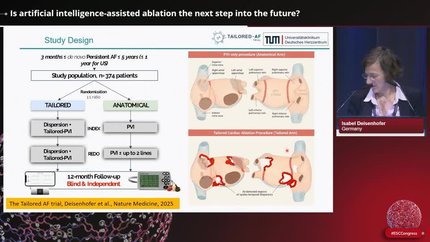
Recently, the TAILORED-AF randomized clinical trial (NCT04702451) demonstrated superiority of targeting dispersion in addition to PVI identified by an artificial intelligence (AI) software over a PVI-only strategy in persistent atrial fibrillation (AF). Ablation at the left atrial anterior wall is common with this ablation approach. Atrial contractility after such an ablation approach has never been investigated.
To investigate the left atrial contractility after a TAILORED-AF ablation approach performed for persistent AF.
We conducted a single-center, non-randomized retrospective study of persistent AF patients who underwent a first-time catheter ablation in stable sinus rhythm. All patients underwent the TAILORED-AF approach of AI-guided spatiotemporal dispersion ablation in addition to PVI. First, electro-anatomical biatrial mapping was performed and the AI-guided spatiotemporal dispersion software was employed to detect dispersion area in real time intracardiac electrograms. Then, PVI and dispersion ablation were performed with the open-irrigated contact force-sensing radiofrequency ablation catheter using high-power short-duration ablation. All patients underwent a transmitral flow evaluation using pulse-wave doppler in stable sinus rhythm at 22 ± 10 months.
Of the 24 patients included (age: 69.73±8.4 years; female: 26%; body mass index: 28.03±4.32 kg/m²; left ventricular ejection fraction: 59±11%; cardiomyopathy: 21%; CHADS2-VASc: 1.89+-1.33, All patients had persistent AF (52% had long-standing persistent AF) and thus had no atrial contraction. Ablation at the anterior wall was performed in all patients with an extensive ablation in 9/19 (47%) and a complete anterior line in 7/19 (37%). All patients were in stable sinus rhythm without symptoms at 22 ± 10 months follow up. In all patients we observed an A wave recovery during the evaluation with an A wave velocity equal to 0.5±0.2 m/s and an E/A ratio equal to 1.8±0.4 (figure below).
This study demonstrates that despite an ablation at anterior wall in all patients, the recovery of left atrial contraction after TAILORED-AF procedures was observed in 100% of the patients.
Contributors

H Regragui
Author
J Seitz
Author
C Bars
Author
E Gitenay
Author
J Monteau
Author
A Ayari
Author
E Martinez
Author
S Siame
Author
A Ballatore
Author
S Lotteau
Author
M S Nguyen-Tu
Author
P Milpied
Author
J Kalifa
Author
You may be interested in