Deep neural network-based estimation of cardiac position using body surface potential maps
EP Europace Journal


Abstract
Accurate estimation of cardiac position is crucial for Electrocardiographic Imaging (ECGI), a technique that enables non-invasive mapping of cardiac electrical activity for advanced diagnostics and treatment planning. While traditional methods, such as MRI or CT, require costly and time-intensive procedures, Body Surface Potential Mapping (BSPM) offers a way to estimate the cardiac position without the need of image acquisition. However, directly inferring cardiac position from BSPM data remains a complex task due to high variability among patients.
This study aims to validate a deep neural network model that estimates the spatial position of the heart using only BSPM data, offering a rapid and non-invasive alternative to compute ECGI.
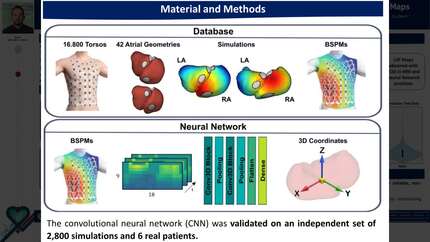
A database containing 16,800 simulations was used, covering both sinus and ectopic stimulations across 42 different atrial geometries placed at random physiological locations. These signals were then propagated to 16,800 torso models, generated using a Statistical Shape Model (SSM), with added gaussian noise to produce realistic BSPM signals.
A convolutional neural network (CNN) was designed to estimate the heart's 3D coordinates from BSPM signals. The model was validated on an independent set of 2,800 simulations, with different cardiac and torso geometries to ensure model robustness. To evaluate performance on real data, 6 patients with cardiac geometries segmented from MRI and both sinus and pacing recordings were selected. Local Activation Time maps (LATs) from ECGI were also compared between the MRI real position and the model estimation. For both validation datasets, root mean squared error (RMSE) between centroids were considered as performance metric.
The model achieved a mean RMSE of 4.76 ± 2.3 mm for cardiac position in the test simulation dataset (Fig.A) and 9.23 ± 6.35 mm on real patient data, where complexity was higher. The model showed strong accuracy across anatomical variations despite increased error in real data (possibly due to cardiac movement). LATs maps computed from estimated positions closely matched originals (Fig.B), supporting its robustness and potential applicability in clinical settings.
Our findings indicate that a BSPM-based neural network model can reliably estimate cardiac position, presenting a viable, non-invasive alternative for ECGI applications and reducing reliance on costly imaging techniques while maintaining positional accuracy. A. Error of location B. Patient example
Contributors

A Cano-Cabanero
Author
R Moreno-Lopez
Author
C Herrero-Martin
Author
E Zacur
Author
I Hernandez-Romero
Author
J V Manjon
Author
A M Climent
Author
R Molero
Author
M S Guillem
Author
You may be interested in