Smartphone application-based heart rhythm management around cardioversion in patients with presumed persistent atrial fibrillation: feasibility substudy of TeleConvert-AF
EP Europace Journal


Abstract
A proportion of patients with presumed persistent AF, who are scheduled for electrical cardioversion (ECV), appear to have a paroxysmal AF pattern or convert spontaneously to sinus rhythm (SR) on the ECV waiting list. This results in unnecessary visits or interventions for patients, and costs and burden for the hospitals and health insurances. TeleConvert-AF is a prospective multicentre cohort study testing the effect of smartphone application-based heart rhythm monitoring around an elective ECV on cancelling unnecessary ECV appointments in case of paroxysmal AF patterns or spontaneous conversion of AF to SR in patients with presumed persistent AF scheduled for ECV.
This substudy of the TeleConvert-AF study assesses the feasibility of the smartphone application-based heart rhythm monitoring to detect paroxysmal AF patterns and spontaneous conversion of AF to SR in patients on the waiting list of an elective ECV.
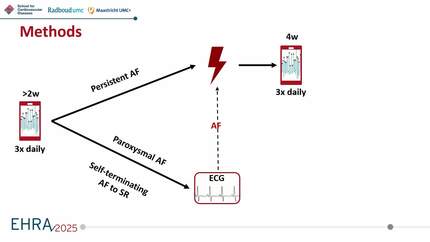
Patients aged ≥18 years with presumed persistent AF on the waiting list for an elective ECV were invited to participate. Reasons for exclusion were the presence of a cardiac device or the inability to use a smartphone application. Patients were instructed to perform three heart rate and rhythm recordings daily using a photoplethysmography (PPG)-based mobile app. Recordings were performed for a minimum of two weeks prior to ECV until four weeks follow-up. Recordings were evaluated by the investigators daily, and when changes in rhythm were observed patients were referred for electrocardiogram (ECG). ECV was cancelled in case of objective spontaneous conversion or paroxysmal AF. The primary endpoint is the occurrence of a paroxysmal AF pattern or self-terminating AF to SR. The secondary endpoint is recurrence of AF after ECV.
Up to now, 824 patients were screened and 233 patients agreed to participate in this study. Overall, adherence to the instruction to perform three heart rate and rhythm recordings daily has been optimal. According to the preliminary analysis of the first 120 patients (median age of 68 years [61.25-73.75], 70% male), paroxysmal AF patterns were observed in six patients (5.0%) and 13 patients (10.8%) showed a spontaneous conversion to SR on PPG recordings by the smartphone-application, which could be confirmed by a 12 lead resting ECG. Of 92 patients (76.7%), were ECV was acutely successful and were the patients left the hospital in SR, PPG recordings by the smartphone-application detected a recurrence of either persistent or paroxysmal AF within the 4-week follow-up period in 51 patients (55.4%), which could be confirmed by ECG.
The TeleConvert-AF approach is feasible. PPG can accurately detect spontaneous conversion to SR and paroxysmal AF in patients waiting for an elective ECV. The effect of the TeleConvert-AF approach on ECV cancelation and the integration into AF treatment plans is currently investigated in the ongoing prospective TeleConvert-AF study.
Contributors

You may be interested in