Continuous QTc interval trends in male and female patient groups with implanted insertable cardiac monitors undergoing antiarrhythmic drug loading
EP Europace Journal


Abstract
Variance in QTc intervals can clinically lead to arrhythmias and sudden cardiac death. Pharmacotherapy including antiarrhythmic drugs (AAD) are known to prolong QT interval. An insertable cardiac monitor (ICM) capable of continuously monitoring QT interval over a long period can be a useful tool for evaluating and managing patients taking QT prolonging drugs.
To analyze QTc interval changes observed from real-world male and female patients with ICM undergoing AAD loading in the hospital.
The QT detection algorithm detects T-waves and determines the QTc intervals for every beat, thus providing continuous long-term QTc trends from ICM ECG. Data was sourced from a de-identified Electronic Health Record (EHR) database linked with ICM device data warehouse. Male and Female patients who were administered sotalol, amiodarone or dofetilide for the first time in the hospital were analyzed. Matched patients who did not undergo AAD loading were selected as the control group. QTc intervals were reported for 30 days before and 90 days after AAD administration. For control patients, a random 120 day period was selected. QTc intervals from days 1-30 before hospitalization were compared with QTc intervals from days 1-30, 30-60, and 60-90 days after hospitalization. Comparisons between female and male patients were performed using the Wilcoxon rank sum test.
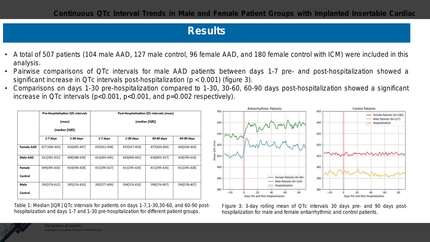
A total of 507 patients (104 male AAD, 127 male control, 96 female AAD, and 180 female control with ICM) were included in this analysis. Figure 1 reports the median [IQR] QTc intervals for all patients on days 1-7, 1-30, 30-60, and 60-90 post-hospitalization and days 1-7 and 1-30 pre-hospitalization for both the groups. Pairwise comparisons of QTc intervals for both male and female AAD patients between days 1-7 pre- and post-hospitalization showed a significant increase in QTc intervals post-hospitalization (p<0.001) (figure 2). Comparisons on days 1-30 pre-hospitalization compared to 1-30, 30-60, 60-90 days post-hospitalization showed a significant increase in QTc intervals for both males and females (p<0.001). Female AAD patients had significantly higher QTc on days 1-7, 1-30, 30-60, 60-90 after hospitalization p=0.017, p< 0.001, p<0.001, and p<0.001 compared to male AAD patients. In the AAD group, 22 (23%), 36 (36%), and 47 (49%) of females crossed the QTc threshold ≥500 msec, ≥480 msec, and ≥470 msec, respectively, after hospitalization compared to 10 (10%), 26 (25%), and 34 (33%) of males crossing the thresholds after hospitalization.
There is a significant increase in QTc intervals for both male and female patients undergoing initial AAD loading, as detected by ICM monitoring. Females had statistically higher QTc interval after AAD loading compared to males which may indicate increased risk of arrhythmias. Continuous QTc monitoring via ICM can detect these dynamic QTc changes and allow for AAD dosage modifications to prevent arrhythmias.
Contributors

A F Chu
Author
V Sagi
Author
M Deus
Author
G Rajagopal
Author
S R Landman
Author
S Sarkar
Author
Y Cho
Author
A K Amin
Author
You may be interested in