Abstract
Patients with heart failure and reduced ejection fraction (HFrEF) commonly develop atrial fibrillation (AF) (1), and this portends worsening morbidity and prognosis (2). Identifying patients with HFrEF most likely to develop AF may enable targeted interventions or enhanced monitoring. The Future Innovations in Novel Detection of Atrial Fibrillation (FIND-AF) algorithm accurately predicts AF risk (3, 4), but it is unclear whether high-risk HFrEF individuals show structural cardiac differences indicating a 'pre-AF' substrate.
This study evaluates cardiac structural changes detectable via cardiac magnetic resonance (CMR) imaging in HF patients by FIND-AF score.
We included patients from the MATCH 1 and MATCH 2 cohorts (2018-2024), which enrolled patients aged ≥ 18 years old diagnosed with HFrEF and subsequently referred for CMR imaging. CMR images were analysed using cvi42 software for volumetric and T1/T2 analysis. The FIND-AF score was calculated using the published algorithm (5). We conducted multiple univariate linear regression analyses for each CMR variable and FIND-AF score, stratified by the presence of AF at the time of the scan.
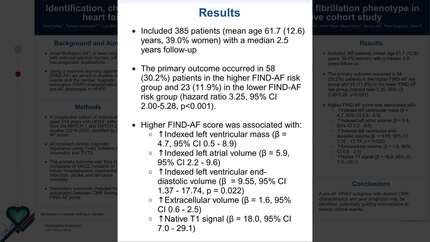
581 Patients (mean age 62.9 ± 12.1 years, 65.9% male) were included, with 33.6% (n = 195) having known AF, where the comorbidity burden was higher (Table 1). In the overall population high FIND-AF scores correlated significantly with increased left atrial volumes (LA) (p = 0.006), pulmonary capillary wedge pressure (PCWP) (p = 0.003) and decreased left ventricular ejection fraction (LVEF) (p <0.001) (Figure 1). This also extended to patients without AF at the time of the scan, where higher FIND-AF scores were associated with increased LA volume (p = 0.022), decreased LVEF (p = 0.002), and increased PCWP (p = 0.013).
Individuals with HF but without AF at high FIND-AF risk have structural and functional changes consistent with a pre-AF state, and thus may be appropriate for enhanced surveillance and preventative interventions.

You may be interested in