Relation of neutrophil gelatinase-associated lipocalin (NGAL) levels and in-hospital outcomes of ST-segment elevation myocardial infarction patients
European Heart Journal - Acute CardioVascular Care


Abstract
Type of funding sources: None.
Neutrophil gelatinase-associated lipocalin (NGAL) is a sensitive maker of both clinical and subclinical acute kidney injury (AKI). This glycoprotein is also stored in granules of mature neutrophils and is significantly increased in patients with myocardial infarction compared with patients with stable coronary artery disease or healthy subjects. Only limited data is present however, regarding the prognostic implications of NGAL in myocardial infraction patients.
We evaluated the possible relation between NGAL levels and in-hospital outcomes in ST elevation myocardial infarction (STEMI) patients.
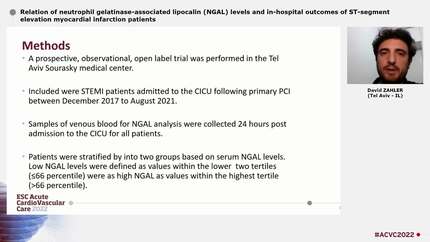
We included 267 patients with STEMI treated with primary coronary intervention. Blood samples for plasma NGAL were collected 24 hours following PCI. We assessed the relation of high serum NGAL, defined as values within the upper tertile (> 66th percentile) and various parameters including left ventricular ejection fraction, AKI, In-hospital adverse events (heart failure symptoms, need for inotropes or 30-day mortality) as well as 30-day mortality alone.
Patients having high NGALs levels (n=89) were more likely to have LVEF < 45% (40% vs. 25%, p=0.009), AKI (43% vs. 4.5%, P<0.001), a composite of in-hospital adverse outcomes (58% vs. 39%, p=0.003) and 30-day mortality (4.5% vs. 0.6%, p=0.04). High NGAL levels were also associated with longer hospital stay and C-reactive protein levels. In a multivariate regression model high NGAL levels were independently associated with in-hospital adverse outcomes (OR 2.03, 95%CI: 1.19 - 3.46, p=0.009).
Elevated NGAL levels suggesting increased inflammation are common among STEMI patients and may be a marker of adverse outcomes.
Contributors


You may be interested in