Feasibility and accuracy of real-time 3D-holographic graft length measurements
European Heart Journal - Digital Health


Abstract
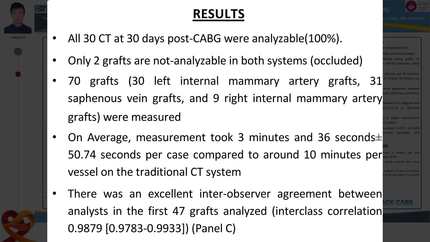
Mixed reality (MR) holograms can display high-definition images while preserving the user’s situational awareness. New MR software can measure 3D objects with gestures and voice commands; however, these measurements have not been validated. We aimed to assess the feasibility and accuracy of using 3D holograms for measuring the length of coronary artery bypass grafts.
An independent core lab analyzed follow-up computer tomography coronary angiograms performed 30 days after coronary artery bypass grafting in 30 consecutive cases enrolled in the FASTTRACK CABG trial. Two analysts, blinded to clinical information, performed holographic reconstruction and measurements using the CarnaLife Holo software (Medapp, Krakow, Poland). Inter-observer agreement was assessed in the first 20 cases. Another analyst performed the validation measurements using the CardIQ W8 CT system (GE Healthcare, Milwaukee, Wisconsin). Seventy grafts (30 left internal mammary artery grafts, 31 saphenous vein grafts, and 9 right internal mammary artery grafts) were measured. Holographic measurements were feasible in 97.1% of grafts and took 3 minutes 36 s ± 50.74 s per case. There was an excellent inter-observer agreement [interclass correlation coefficient (ICC) 0.99 (0.97–0.99)]. There was no significant difference between the total graft length on hologram and CT [187.5 mm (157.7–211.4) vs. 183.1 mm (156.8–206.1),
Real-time holographic measurements are feasible, quick, and accurate even for tortuous bypass grafts. This new methodology can empower clinicians to visualize and measure 3D images by themselves and may provide insights for procedural strategy.
Contributors

Tsung-Ying Tsai
Author
Shigetaka Kageyama
Author
XingQiang He
Author
Giulio Pompilio
Author
Daniele Andreini
Author
Gianluca Pontone
Author

Johan De Mey
Author
Kaoru Tanaka
Author
Torsten Doenst
Author
John Puskas
Author
Ulf Teichgräber
Author
Ulrich Schneider
Author
Himanshu Gupta
Author
Jonathon Leipsic
Author

Scot Garg
Author
Royal Blackburn Hospital Blackburn , United Kingdom of Great Britain & Northern Ireland
Pruthvi C. Revaiah
Author
Maciej Stanuch
Author
Andrzej Skalski
Author
Yoshinobu Onuma
Author
Patrick W Serruys
Author
You may be interested in