Mobile/wearable digital devices for care of active cancer patients: a survey from the ESC Council of Cardio-Oncology
European Heart Journal - Digital Health


Abstract
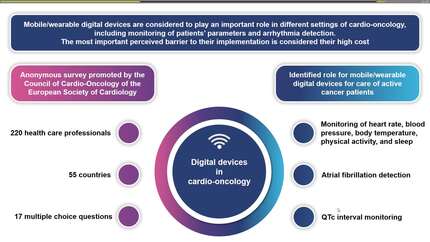
The Council of Cardio-Oncology of the European Society of Cardiology developed an on-line anonymous survey to provide an overall picture of the current practice on the use of mobile and wearable digital devices in cardio-oncology and the potential barriers to their large-scale applicability.
Between June 2023 and January 2024, an online anonymous questionnaire was completed by 220 healthcare professionals from 55 countries. The greatest number of respondents reported that mobile/wearable digital devices have a role in all active cancer patients for measuring heart rate (33.9%), blood pressure (34.4%), body temperature (32.0%), physical activity (42.4%), and sleep (31.2%). In the setting of atrial fibrillation detection, respondents were evenly split between applying these technologies in all patients (33.0%) or only in selected patients (33.0%). Regarding QTc interval monitoring, 30.6% reported that mobile/wearable digital devices play a role only in selected patients. The decision to use the device was taken by the patient in 56.6% of cases and the physician in 43.4%. The most important barrier reported to mobile/wearable device implementation in the setting of cardiac rhythm monitoring and QTc measurement was their cost (weighted average: 3.38 and 3.39, respectively).
Mobile/wearable digital devices are considered to play an important role in different settings of cardio-oncology, including monitoring of patients’ parameters and arrhythmia detection. Their role in monitoring physical activity and QTc interval appears more nuanced. The most important perceived barrier to mobile/wearable digital device implementation is considered their high cost.
Contributors



Pietro Ameri
Author
Davide A Mei
Author
Michał Farkowski
Author
Julian Chun
Author

Teresa Lopez-Fernandez
Author
Alexander R Lyon
Author
You may be interested in