Subcutaneous implantable cardioverter-defibrillator was inappropriate for use in a patient with aborted sudden cardiac death due to coronary spastic angina: a case report
European Heart Journal - Case Reports


Abstract
Implantable cardioverter-defibrillator (ICD) is recommended for secondary prevention in patients with coronary spastic angina and aborted sudden cardiac death. The effectiveness of subcutaneous ICD (S-ICD) for patients with coronary artery spastic angina is controversial.
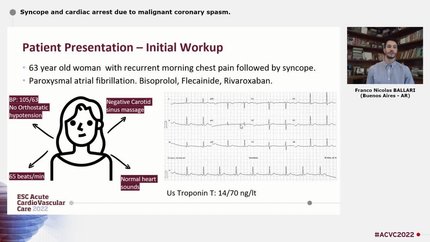
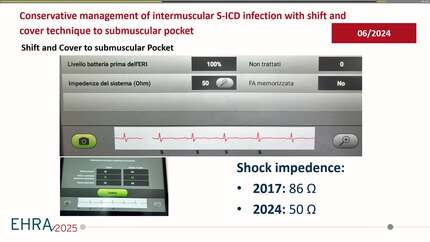
A 54-year-old man presented with ventricular fibrillation. Emergent coronary angiography showed diffuse narrowing of the coronary arteries that was reversible with isosorbide dinitrate. He was diagnosed with coronary spastic angina. S-ICD was implanted after the administration of a calcium-channel blocker and nicorandil. Seven months after the implantation, he collapsed again due to sinus node dysfunction and atrioventricular block caused by cardiac ischaemia. He developed cardiac arrest at both admissions. Six hours after the admission, electrocardiogram showed transient right bundle branch block. Inappropriate shocks were delivered because of low R-wave amplitude and T-wave oversense. S-ICD was replaced with a transvenous device in order to manage these two arrhythmias and inappropriate shocks.
Patients with coronary artery spasm and aborted sudden cardiac death are candidates for implantation of S-ICD, but there are risks of bradycardia and inappropriate shocks in other ischaemic events.
Contributors

Akiteru Kojima
Author
Takeshi Shirayama
Author
Jun Shiraishi
Author
Takahisa Sawada
Author
Habib Rehman Khan
Author
Albert Galyavich
Author
Konstantinos Iliodromitis
Author
Abdelrahman Ibrahim Abushouk
Author
Nida Ahmed
Author
You may be interested in