Early and late-onset syncope: insight into mechanisms

European Heart Journal

9 February 2022
Organised by: Logo
ESC Journals ARRHYTHMIAS AND DEVICE THERAPY Syncope and Bradycardia

Abstract

AbstractAims

Unexplained syncope is an important clinical challenge. The influence of age at first syncope on the final syncope diagnosis is not well studied.

Methods and results

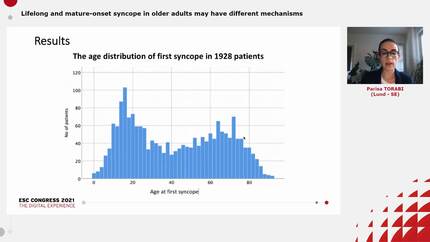
Consecutive head-up tilt patients (n = 1928) evaluated for unexplained syncope were stratified into age groups <30, 30–59, and ≥60 years based on age at first syncope. Clinical characteristics and final syncope diagnosis were analysed in relation to age at first syncope and age at investigation. The age at first syncope had a bimodal distribution with peaks at 15 and 70 years. Prodromes (64 vs. 26%, P < 0.001) and vasovagal syncope (VVS, 59 vs. 19%, P < 0.001) were more common in early-onset (<30 years) compared with late-onset (≥60 years) syncope. Orthostatic hypotension (OH, 3 vs. 23%, P < 0.001), carotid sinus syndrome (CSS, 0.6 vs. 9%, P < 0.001), and complex syncope (>1 concurrent diagnosis; 14 vs. 26%, P < 0.001) were more common in late-onset syncope. In patients aged ≥60 years, 12% had early-onset and 70% had late-onset syncope; older age at first syncope was associated with higher odds of OH (+31% per 10-year increase, P < 0.001) and CSS (+26%, P = 0.004). Younger age at first syncope was associated with the presence of prodromes (+23%, P < 0.001) and the diagnoses of VVS (+22%, P < 0.001) and complex syncope (+9%, P = 0.018).

Conclusion

In patients with unexplained syncope, first-ever syncope incidence has a bimodal lifetime pattern with peaks at 15 and 70 years. The majority of older patients present only recent syncope; OH and CSS are more common in this group. In patients with early-onset syncope, prodromes, VVS, and complex syncope are more common.

Contributors

Parisa Torabi
Parisa Torabi

Author

Central Hospital of Vaxjo Vaxjo , Sweden

Viktor Hamrefors
Viktor Hamrefors

Author

Lund University Malmo , Sweden

Richard Sutton
Richard Sutton

Author

Imperial College London London , United Kingdom of Great Britain & Northern Ireland

Michele Brignole
Michele Brignole

Author

Italian Auxological Institute IRCCS San Luca Hospital Milano , Italy

Artur Fedorowski
Artur Fedorowski

Author

Karolinska University Hospital Stockholm , Sweden