Aortic valve replacement vs. conservative treatment in asymptomatic severe aortic stenosis: long-term follow-up of the AVATAR trial
European Heart Journal


Abstract
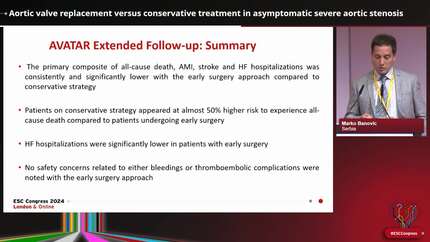
The question of when and how to treat truly asymptomatic patients with severe aortic stenosis (AS) and normal left ventricular (LV) systolic function is still subject to debate and ongoing research. Here, the results of extended follow-up of the AVATAR trial are reported (NCT02436655,
The AVATAR trial randomly assigned patients with severe, asymptomatic AS and LV ejection fraction ≥ 50% to undergo either early surgical aortic valve replacement (AVR) or conservative treatment with watchful waiting strategy. All patients had negative exercise stress testing. The primary hypothesis was that early AVR will reduce a primary composite endpoint comprising all-cause death, acute myocardial infarction, stroke, or unplanned hospitalization for heart failure (HF), as compared with conservative treatment strategy.
A total of 157 low-risk patients (mean age 67 years, 57% men, mean Society of Thoracic Surgeons score 1.7%) were randomly allocated to either the early AVR group (
The extended follow-up of the AVATAR trial demonstrates better clinical outcomes with early surgical AVR in truly asymptomatic patients with severe AS and normal LV ejection fraction compared with patients treated with conservative management on watchful waiting.
Contributors


Svetozar Putnik
Author
Bruno R Da Costa
Author
Martin Penicka
Author
Marek A Deja
Author
Martin Kotrc
Author
Radka Kockova
Author

Hrvoje Gasparovic
Author
Nikola Pavlovic
Author
Lazar Velicki
Author

Stefano Salizzoni
Author
A.O.U. Citta Della Salute E Della Scienza Di Torino Molinette Turin , Italy
Wojtek Wojakowski
Author

Sinisa Gradinac
Author
Michael Laufer
Author
Sara Tomovic
Author
Ivan Busic
Author
Milica Bojanic
Author

Andrea Klasnja
Author
Milos Matkovic
Author
Nikola Boskovic
Author
Katarina Zivic
Author
Miodrag Jovanovic
Author
Serge D Nikolic
Author
Bernard Iung
Author
You may be interested in