The activator protein-1 complex governs a vascular degenerative transcriptional programme in smooth muscle cells to trigger aortic dissection and rupture
European Heart Journal


Abstract
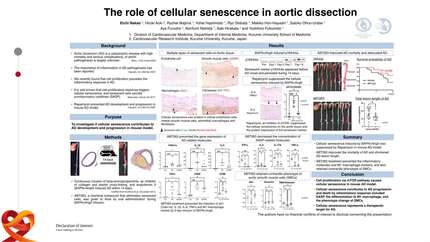
Stanford type A aortic dissection (AD) is a degenerative aortic remodelling disease marked by an exceedingly high mortality without effective pharmacologic therapies. Smooth muscle cells (SMCs) lining tunica media adopt a range of states, and their transformation from contractile to synthetic phenotypes fundamentally triggers AD. However, the underlying pathomechanisms governing this population shift and subsequent AD, particularly at distinct disease temporal stages, remain elusive.
Ascending aortas from nine patients undergoing ascending aorta replacement and five individuals undergoing heart transplantation were subjected to single-cell RNA sequencing. The pathogenic targets governing the phenotypic switch of SMCs were identified by trajectory inference, functional scoring, single-cell regulatory network inference and clustering, regulon, and interactome analyses and confirmed using human ascending aortas, primary SMCs, and a β-aminopropionitrile monofumarate–induced AD model.
The transcriptional profiles of 93 397 cells revealed a dynamic temporal-specific phenotypic transition and marked elevation of the activator protein-1 (AP-1) complex, actively enabling synthetic SMC expansion. Mechanistically, tumour necrosis factor signalling enhanced AP-1 transcriptional activity by dampening mitochondrial oxidative phosphorylation (OXPHOS). Targeting this axis with the OXPHOS enhancer coenzyme Q10 or AP-1-specific inhibitor T-5224 impedes phenotypic transition and aortic degeneration while improving survival by 42.88% (58.3%–83.3% for coenzyme Q10 treatment), 150.15% (33.3%–83.3% for 2-week T-5224), and 175.38% (33.3%–91.7% for 3-week T-5224) in the β-aminopropionitrile monofumarate–induced AD model.
This cross-sectional compendium of cellular atlas of human ascending aortas during AD progression provides previously unappreciated insights into a transcriptional programme permitting aortic degeneration, highlighting a translational proof of concept for an anti-remodelling intervention as an attractive strategy to manage temporal-specific AD by modulating the tumour necrosis factor–OXPHOS–AP-1 axis.
Contributors

Yongting Luo
Author
Junjie Luo
Author
Peng An
Author
Yuanfei Zhao
Author
Wenting Zhao
Author
Zhou Fang
Author
Yi Xia
Author
Lin Zhu
Author
Teng Xu
Author
Xu Zhang
Author
Shuaishuai Zhou
Author
Mingyan Yang
Author
Jiayao Li
Author
Junming Zhu
Author
Yongmin Liu
Author
Haiyang Li
Author
Ming Gong
Author
Yuyong Liu
Author
Jie Han
Author
Huiyuan Guo
Author
Hongjia Zhang
Author
Wenjian Jiang
Author
Fazheng Ren
Author
You may be interested in