Coronary bypass surgery guided by computed tomography in a low-risk population
European Heart Journal


Abstract
In patients with three-vessel disease and/or left main disease, selecting revascularization strategy based on coronary computed tomography angiography (CCTA) has a high level of virtual agreement with treatment decisions based on invasive coronary angiography (ICA).
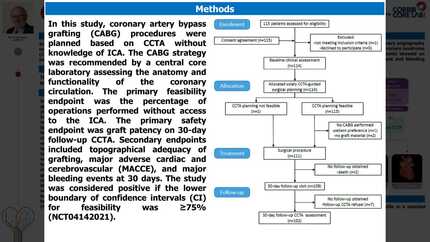
In this study, coronary artery bypass grafting (CABG) procedures were planned based on CCTA without knowledge of ICA. The CABG strategy was recommended by a central core laboratory assessing the anatomy and functionality of the coronary circulation. The primary feasibility endpoint was the percentage of operations performed without access to the ICA. The primary safety endpoint was graft patency on 30-day follow-up CCTA. Secondary endpoints included topographical adequacy of grafting, major adverse cardiac and cerebrovascular (MACCE), and major bleeding events at 30 days. The study was considered positive if the lower boundary of confidence intervals (CI) for feasibility was ≥75% (NCT04142021).
The study enrolled 114 patients with a mean (standard deviation) anatomical SYNTAX score and Society of Thoracic Surgery score of 43.6 (15.3) and 0.81 (0.63), respectively. Unblinding ICA was required in one case yielding a feasibility of 99.1% (95% CI 95.2%–100%). The concordance and agreement in revascularization planning between the ICA- and CCTA-Heart Teams was 82.9% with a moderate kappa of 0.58 (95% CI 0.50–0.66) and between the CCTA-Heart Team and actual treatment was 83.7% with a substantial kappa of 0.61 (95% CI 0.53–0.68). The 30-day follow-up CCTA in 102 patients (91.9%) showed an anastomosis patency rate of 92.6%, whilst MACCE was 7.2% and major bleeding 2.7%.
CABG guided by CCTA is feasible and has an acceptable safety profile in a selected population of complex coronary artery disease.
Contributors


Shigetaka Kageyama
Author
Giulio Pompilio
Author
Daniele Andreini
Author

Saima Mushtaq
Author

Johan De Mey
Author
Kaoru Tanaka
Author

Ulf Teichgräber
Author
Ulrich Schneider
Author
John D Puskas
Author

Jagat Narula
Author
University of Texas Health Science Center At Houston Houston , United States of America
Himanshu Gupta
Author
Vikram Agarwal
Author
Jonathon Leipsic
Author
Shinichiro Masuda
Author
Nozomi Kotoku
Author
Tsung-Ying Tsai
Author

Scot Garg
Author
Royal Blackburn Hospital Blackburn , United Kingdom of Great Britain & Northern Ireland
Marie-Angele Morel
Author

You may be interested in