Abstract
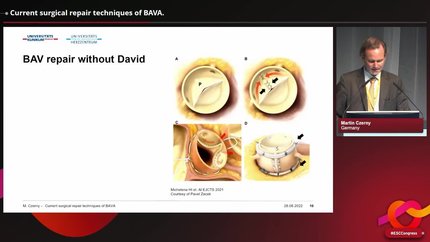
Severe aortic valve regurgitation, if not timely treated, can significantly impact patients’ survival both for tricuspid aortic valve and bicuspid aortic valve patients, with the latter being significantly younger. Increased understanding of the root anatomy and its physiology has opened the way to techniques of aortic valve repair surgery. The techniques mainly relate to re-establishing a correct root and annular geometry and eliminating leaflet prolapse. These techniques are applied both in the presence of a dilated and normal root and are equally valid for tricuspid or bicuspid valve. Techniques for repairing a bicuspid valve might vary depending on the different valve phenotypes. Medium and long-term results appear favourable and potentially superior to those of prosthetic replacement in terms of valve-related complications and quality of life. Optimal surgical treatment, especially in younger and selected patients, should aim to avoid aortic valve replacement and its related complications.
Contributors

Ilaria Chirichilli
Author
Laurent de Kerchove
Author
Alessandro Della Corte
Author
Gebrine El Khoury
Author
Hector I Michelena
Author
Andrea Salica
Author
Hans-Joachim Schäfers
Author
You may be interested in