Examining the impact of a 10-week HIIT exercise program on recent cardiac rehabilitation graduates: a case for cardiac maintenance
European Journal of Preventive Cardiology


Abstract
Exercise-based cardiac rehabilitation has been shown to improve aerobic capacity and mental health (i.e. anxiety and depression) and reduce the risk of a secondary cardiac event. Following hospital-based cardiac rehabilitation programs, patients are left largely on their own to return to their normal routines with no continuation of support for continued exercise training; many lack sufficient exercise experience and confidence to continue a regimen independently. High intensity interval training (HIIT) is effective when integrated into cardiac rehabilitation, but its effectiveness in a community setting is not established.
To evaluate implementation of a HIIT exercise protocol into a community cardiac maintenance program, developed to provide supervised exercise training for graduates of hospital-based cardiac rehabilitation.
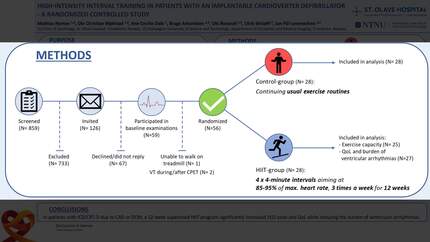
Recent (<1 year) graduates of hospital based cardiac rehabilitation patients were recruited to complete the 10-week program. Exercise sessions occurred 3 days per week for 50 minutes per session and consisted of the following: 1 day of strength training, 1 day of individual HIIT, and 1 day of group-based HIIT. Intensity prescription was based on ratings of perceived exertion (RPE). Aerobic intervals consisted of 4 minutes of high intensity (i.e. RPE of 15-17) and 3 minutes of low intensity (i.e. RPE of 9-11) on a modality of the participants choosing. RPE was recorded at the beginning, mid-point, and end of each interval to ensure intensity targets were being met. Assessments were completed at pre- and post-program for (1) physical fitness using the Seniors Fitness test; (2) mental health using the hospital anxiety and depression scale (HADS) and subscales HADS, for anxiety (HADS-A) and depression (HADS-D); and, (3) self-efficacy using the self-efficacy for exercise (SEE) questionnaire.
To date, 17 participants (age: 66.9 ± 7.6 years (range: 48-75) [100% male]) have completed the 10-week HIIT program, and data collection is ongoing. Significant improvements have been observed in physical fitness, specifically in the 6MWT (pre: 526 post: 570m; p-value = <0.01) and in SEE (pre: 30.7 ± 9.0 post: 73.9 ± 12.8, p-value = <0.01). While no significant changes have occurred in the HADS-A (pre: 3.8 ± 3.4 post: p-value = 0.22) or HADS-D (pre: 3.9 ± 2.1, post: 2.2 ± 1.9; p-value = 0.17) clinically meaningful changes were noted in the HADS-D.
These results suggest that continued supervised exercise training in a community setting is effective for improving physical and mental health and increases self-efficacy for exercise in recent hospital-based cardiac rehabilitation settings. Future research should evaluate ways to increase female participation.
Contributors

You may be interested in