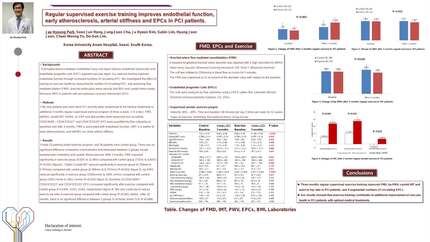
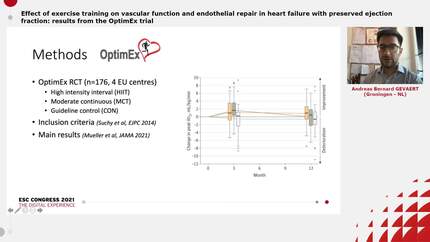
The assessment of the impact of physical exercise level on the quantity of endothelial cell precursor progenitor cells in patients after ACS on the background of cardiac rehabilitation measures
European Journal of Preventive Cardiology


Abstract
At the present stage, there are discussions about the predictive value of the level of progenitor cells of endothelial cell precursors (EPCs) in peripheral blood for cardiovascular complications in high-risk patients, particularly after acute myocardial infarction. Since endothelial dysfunction is one of the initiating mechanisms of myocardial infarction, it is important to assess the risks of recurrent cardiovascular events in patients during cardiac rehabilitation with increased physical exercise.
To identify the correlation between the restoration of physical exercise tolerance (PET) level and the quantity of EPCs in peripheral blood of patients after acute coronary syndrome (ACS).
Ninety male patients were examined, including 79 (87.8±6.8%) with a diagnosis of myocardial infarction, of which 65 (82.3±8.4%) had STEMI and 14 (17.7±8.4%) had NSTEMI, and 11 (12±6.8%) with unstable angina. Among the comorbidities, hypertension was present in all patients (100±4.1%), diabetes mellitus in 23 (25.6±9.0%), obesity in 25 (27.8±9.3%), and overweight in 29 (32.2±9.7%). Grade II heart failure was observed in 65 patients (72.2±9.3%). The mean age of the examined patients was (56.5±10.5) years. Coronary angiography revealed atherosclerotic involvement of one vessel in 23 patients (25.6±9.0%), two vessels in 26 (28.9±9.4%), and three vessels in 41 (45.6±10.3%). Hemodynamically significant three-vessel involvement was found in 24 patients (26.7±9.1%), two-vessel involvement in 31 (34.4±9.8%), and one-vessel involvement in 35 (38.9±10.1%).
All patients underwent exercise testing using the graded exercise method, assessment of intracardiac hemodynamics using two-dimensional and Doppler echocardiography, coronary angiography, biochemical and general clinical blood tests, and quantification of EPCs levels in peripheral blood. The results are presented as the mean value with standard deviation or frequency with a 95% confidence interval.
The obtained data indicate that there is an associative relationship between better restoration of PET levels after acute coronary syndrome and the restoration of endothelial function in patients with a favorable course of the post-infarction period during repeated examination, compared to patients whose PET levels did not exceed 50 watts (low PET). This is evidenced by a statistically significant higher number of EPCs after physical exercise in the group with a favorable course and high PET (Group A) compared to the group with an unfavorable course and low PET (Group B).
Studying the response in terms of changes in EPCs quantity in response to physical exercise can help determine the progression of systemic endothelial dysfunction, which affects the patient's prognosis.
Contributors



You may be interested in