Prevalence and predictors of elevated cardiac troponins among athletes after participation in a sports event: a systematic review and meta-analysis
European Journal of Preventive Cardiology


Abstract
Myocardial injury is defined by cardiac troponin (cTn) concentrations above the upper reference limit (URL) and is diagnostic for acute myocardial infarctions if combined with ischemic symptoms, ECG changes, or imaging. However, exercise can increase cTn concentrations above the URL and introduce diagnostic ambiguity for physicians if individuals seek medical attention post-exercise.
To determine the prevalence of elevated cTn concentrations (>URL) after participation in sports events and to identify mediators of elevated cTn concentrations.
A systematic literature search in Pubmed, SPORTDiscus, and Embase was performed on 1 February 2023. Identified articles were screened for in- and exclusion criteria, and eligible articles were entered into a random-effects meta-analysis of cTn prevalence >URL. We calculated study weighting and overall effect size using the restricted maximum likelihood method. Differences in cTn elevations between pre-specified subgroups were tested using the chi-square test, and associations between the prevalence of cTn >URL and continuous mediators were assessed using logistic regression and restricted cubic spline models.
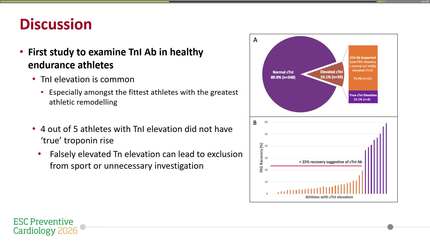
In total, 3,990 articles were identified and screened, and 122 articles were included in the final analyses. The analytical cohort consisted of 7,616 athletes of whom 76.4% were male with an average age of 44 years. The overall post-exercise prevalence of cTn >URL was 35% (95%CI 30–41). The prevalence of cTn >URL was higher when using high-sensitivity assays (55% [44–67]) vs conventional assays (26% [21–32], p<0.001) and for Troponin T (41% [32–50]) vs Troponin I (29% [22–36], p=0.040). Individuals aged ≥40 years were more likely to have elevated cTn >URL (39% [31–47]) compared to peers <40 years (24% [16–33, p=0.018]), while there were no differences between females (38% [19–58]) vs males (31% [23–39], p=0.51). Vigorous-intensity endurance sports had the highest prevalence of cTn >URL, including cycling (36% [21–52]), running (39% [32–46]), and triathlon (48% [24–73]), while we found a lower prevalence of cTn >URL for contact sports (4% [0–13]) and prolonged moderate-intensity walking (7% [4-10]) events (p<0.001). There was a non-linear relationship between exercise duration and the prevalence of cTn >URL (p for non-linearity<0.001), with the highest prevalence for event durations between 3-4 hours (58% [44-72]).
One in three athletes had cTn concentrations >URL following the completion of a sports event. The prevalence was higher when blood samples were analysed with Troponin T assays or high-sensitivity assays and among older athletes or those participating in vigorous-intensity endurance sports with an exercise duration between 3-4 hours.
Contributors




You may be interested in