Air pollution as a trigger for ischemic stroke - retrospective analysis of over 80-million-person years of follow-up (EP-PARTICLES study)
European Journal of Preventive Cardiology


Abstract
In recent years air pollution (AP) has become one of the most important nonclassical risk factors for cardiovascular diseases (CVD). Guidelines suggest that high-risk patients should avoid regions with high AP levels, however, there is a lack of research conducted in areas with low or moderate AP concentrations.
To analyze the effects of AP on ischemic stroke (IS) incidence and identify the most vulnerable age and sex groups. Moreover, we aim to assess, how region settings (such as density of population, alcohol or tobacco consumption, atrial fibrillation (AF) prevalence and CVD mortality) impact the effects of AP.
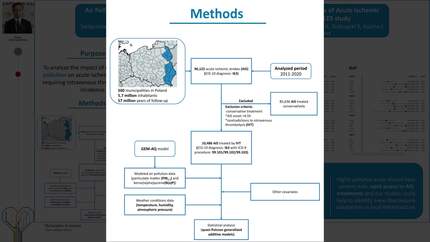
The study covered 709 counties in Poland in 2011-2020. IS incidence data (ICD-10 I63.X) and AP concentrations (PM2.5, NO2, CO, O3, benzo(a)pyrene (B(a)P) and SO2) were obtained from the National Health Fund and Inspectorate for Environmental Protection, respectively. In collaboration with the National Research Institute, taking into account weather conditions and the flow of people, we modeled AP levels for all 709 counties. To analyze the effects of AP we used quasi-Poisson generalized additive models. The covariates were weather conditions, day of the week, bank holidays and seasonal trends. Results are presented as relative risks (RRs) and 95% confidence intervals (95% CI) per interquartile range (IQR) increase in AP on the day of exposure.
We recorded 146,262 cases of IS with a dominance of females (51.2%) and people over 65 years old (77.62%). Exposure to PM2.5, NO2, B(a)P and SO2 increased the risk of ischemic stroke onset by respectively 2.4%, 1%, 0.8% and 0.6% in the overall population on the day of exposure [Figure 1]. We found similar negative effects for the same four air pollutants in the female population and younger adults. None of the analyzed air pollutants had an impact on men, whereas exposure to PM2.5, NO2 and SO2 was associated with an increased risk of IS in the elderly. People in high alcohol and tobacco consumption areas were more vulnerable to AP. There was an association between the increased 4 air pollutants (PM2.5, NO2, B(a)P and SO2) concentrations and the IS risk in low AF prevalence areas. In contrast, only PM2.5 and SO2 had the same effect in the high AF occurrence setting. Exposure to all air pollutants except O3 caused an increased risk of IS in counties with lower CVD mortality rates. The exposure–response associations of AP levels with IS incidence were positive and the curves showed an increase. Then at higher concentrations, the slopes flatten, especially in the case of NO2 and SO2 [Figure 2].
AP might act as a trigger for IS, even at low concentrations. Young, active woman is the most vulnerable phenotype to AP. Harmful health habits seem to further increase the negative effects of AP. "Survival bias" might contribute to the lower influence of AP in high CVD mortality areas. The prevalence of AF seems to not impact the effects of AP. Acute effects of various air pollutants. Exposure–response curves.
Contributors




You may be interested in