Effects of remote cardiac rehabilitation using wearable devices with and without weekly online coaching in patients with coronary artery disease: J-CARP FIT study
European Journal of Preventive Cardiology


Abstract
Cardiac rehabilitation (CR) is effective for preventing cardiovascular diseases, but the impact of remote-CR with wearable devices and online coaching is not well understood. The aim of this study was to investigate its effects on exercise capacity by interactive communication between healthcare providers and patients.
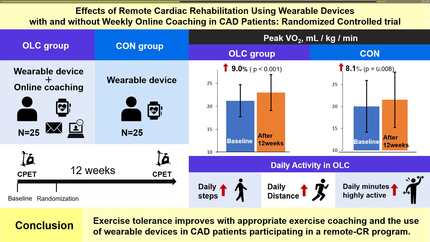
This randomized controlled trial enrolled 50 coronary artery disease (CAD) patients participating in a remote-CR program (phase III). After baseline cardiopulmonary exercise test (CPET), all patients were given a CPET-based home exercise program and were provided wearable device with real-time monitoring system. They were randomly assigned to an intervention group with online coaching (OLC, n=25) or a control group (CON, n=25). Primary outcomes were changes in peak VO2 and anaerobic threshold (AT) VO2 at 12 weeks, while secondary outcomes were changes in CPET parameters, daily activity, anxiety level, and health-related quality of life (HR-QOL).
Peak VO2 and AT VO2 increased significantly from baseline to 12 weeks in the OLC (+1.6 mL/kg/min, p<0.001; +1.0 mL/kg/min, p=0.001) and CON (+0.6 mL/kg/min, p=0.008; +1.3 mL/kg/min, p=0.002) without significant between-group differences (p=0.65; p=0.9). In the latter half of the intervention, daily distance, and highly active time in the OLC group significantly increased compared to the CON group (all p<0.05).
Exercise tolerance improves with appropriate exercise coaching and the use of wearable devices in CAD patients participating in a remote-CR program. However, the benefits of online coaching using real-time monitoring might be more pronounced in a long-term perspective. Timeline Graphical abstract
Contributors



You may be interested in