Combined effects of gamma-glutamyltransferase and high-sensitivity C-reactive protein on cardiovascular events in patients with diabetes and chronic coronary syndrome
European Journal of Preventive Cardiology


Abstract
Gamma-glutamyltransferase (GGT) is widely used for the diagnosis of liver and obstructive biliary diseases and as an indicator of alcohol consumption. Recently, the role of GGT in cardiovascular fields has attracted attention due to the growing awareness of the interaction between the heart and other organs such as the liver and kidney. Epidemiological studies suggest an association between GGT levels and all-cause mortality in patients with coronary artery disease. It has also been observed that an elevated GGT level is associated with cardiovascular risks such as systemic inflammation and metabolic syndrome.
The study aimed to investigate the combined effects of GGT and high-sensitivity C-reactive protein (hs-CRP) on cardiovascular events in patients with diabetes and chronic coronary syndrome (CCS).
This secondary analysis of a multicentre prospective cohort included 4467 diabetic CCS patients. A GGT level of <55 U/L for males or <33 U/L for females is considered to be low. A low hs-CRP level is defined as <2 mg/L. The primary endpoint was all-cause death. The secondary endpoints include cardiac death, non-fatal myocardial infarction, non-fatal stroke, and revascularisation. Associations of GGT and hs-CRP with cardiovascular events were estimated using Cox regression.
Over a median follow-up period of 2.1 years, 82 all-cause deaths occurred. Patients with elevated levels of GGT and hs-CRP experienced the highest risk of all-cause death (adjusted hazard ratio=3.70, 95% confidence interval: 1.86–7.35, p<0.001). Patients with elevated levels of GGT and low levels of hs-CRP had a 2.56-fold risk of all-cause death than those with low levels of both markers. Similar trends were observed for cardiac death. In addition, elevated levels of both GGT and hs-CRP significantly increased the risks of non-fatal myocardial infarction and any revascularisation.
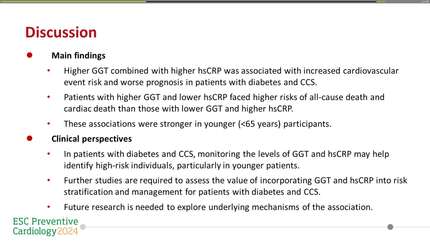
In diabetic CCS patients, GGT and hs-CRP synergistically increased the risk of cardiovascular events. Combining GGT and hs-CRP may help identify high-risk patients. Cox analysis . Kaplan-Meier curves


You may be interested in