The impact of intensive glycemic control on prognosis in diabetes patients with severe coronary artery disease across different age groups
European Journal of Preventive Cardiology


Abstract
Glycemic control is crucial for patients with diabetes mellitus (DM) and coronary artery disease (CAD). Some studies suggested that strict glycemic control does not significantly improve outcomes in patients with DM and CAD. Individualized glycemic control plans should be developed based on the patient's condition. However, there is limited research on the correlation between strict glycemic control and prognosis in patients with severe coronary artery disease, and the optimal level of glycemic control remains unclear.
This study ultimately included 2,051 consecutive patients with triple-vessel coronary disease enrolled from April 2004 to February 2011 at Fuwai Hospital in China, after excluding those with missing glycated hemoglobin (HbA1c) data and with hemoglobin <90 g/L. Patients were categorized into five groups based on their HbA1c levels: <6.0%, 6.0%-6.4%, 6.5%-6.9%, 7.0%-7.9%, and ≥8.0%. The primary endpoint was all-cause death, and the secondary endpoint was major adverse cardiovascular and cerebrovascular events (MACCE), including all-cause death, non-fatal myocardial infarction, and non-fatal stroke.
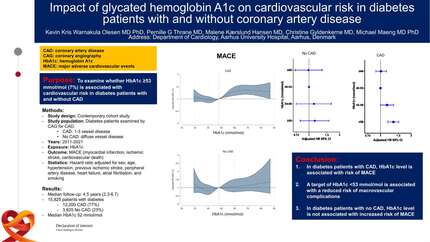
The median follow-up time was 5.88 years. During this period, a total of 323 (15.7%) all-cause deaths and 537 (26.2%) MACCEs were recorded. The relationship between HbA1c levels and the risk of endpoint events showed a non-linear U-shaped pattern. Patients with HbA1c levels between 6.0% and 6.9% had a lower risk of adverse outcomes, while those with HbA1c ≥8.0% had the highest risk of endpoint events. Further analysis revealed a significant interaction between HbA1c and age (p = 0.001). In the subgroup with age <70 years, as HbA1c increased, the risk of adverse events gradually rose, with patients having HbA1c <6.0% exhibiting the lowest risk of death and MACCE. In the subgroup with age ≥70 years, there was an L-shaped relationship between HbA1c levels and endpoint events. Patients with HbA1c <6.0% had a significantly higher risk of death and MACCE compared to other groups. The restricted cubic spline analysis also demonstrated similar results. In patients aged ≥70 years, the risk of death and MACCE gradually increased at HbA1c levels below 6.8% and 7.3%, respectively.
Our study revealed a U-shaped relationship between admission HbA1c levels and adverse outcomes in patients with triple-vessel coronary disease and concomitant diabetes. The descending arm of the U-shaped curves is primarily contributed by older patients, while the ascending arm is mainly contributed by younger patients. In younger patients with triple-vessel coronary disease, strict glycemic control may contribute to improving prognosis. However, in older patients with triple-vessel coronary disease, it is advisable to avoid excessively low HbA1c levels and adopt a more lenient glycemic control approach. Forest plots. Restricted cubic spline plots.

You may be interested in