Platelet-endothelial aggregation receptor 1 inhibits reendothelialization of injured arteries
European Journal of Preventive Cardiology


Abstract
Platelet-endothelial aggregation receptor 1 (PEAR1) is primarily expressed in endothelial cells and platelets. Previous studies have revealed that PEAR1 inhibits neoangiogenesis and suppresses the proliferation of pulmonary microvascular endothelial cells.
The study aims to explore the impact of PEAR1 on the reendothelialization of injured arteries.
The role of PEAR1 in injured endothelial cell proliferation and migration was determined in vitro with human coronary artery endothelial cells (HCAECs). All experiments were performed under IL-1α conditions to replicate an inflammatory environment following wire injury. We constructed three recombinant lentiviral vectors: short hairpin RNA against PEAR1 (sh-PEAR1), PEAR1 overexpression (OE-PEAR1), and non-targeting sh-PEAR1 (sh-PEAR1 NC) as control. The PEAR1-/-knockout mice and wild-type (WT) controls were studied for the response of femoral arteries to angioplasty wire injury. The study adhered to the "Principles of Laboratory Animal Care" and received approval from the Institutional Animal Care and Use Committee (IACUC) (Issue Number: 20230040).
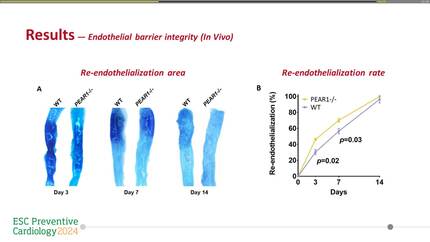
In comparison to the sh-PEAR1 NC group, PEAR1 knockdown significantly enhanced HCAEC proliferation and migration. Conversely, PEAR1 overexpression strongly inhibited HCAEC proliferation and migration (Figure 1). The reendothelialized area in PEAR1-/- arteries was significantly larger than in WT arteries on days 3 and 7 after injury. Moreover, on day 28, PEAR1-/- arteries halved neointima formation compared with WT arteries (Figure 2).
PEAR1 suppresses HCAEC proliferation and migration in the presence of IL-1α. PEAR1 delays reendothelialization and accelerates neointima formation of wire-injured arteries in mice.


You may be interested in