Effect of Behavior-Change Interventions on Daily Physical Activity in Patients with Intermittent Claudication: The OPTIMA Systematic Review and Meta-Analysis
European Journal of Preventive Cardiology


Abstract
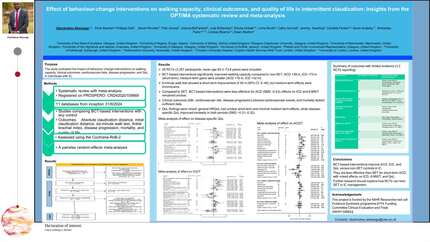
The study aimed to synthesize evidence of daily physical activity (PA) following Behavior-change technique (BCT)-based interventions compared to any control in individuals with peripheral arterial disease/intermittent claudication (PAD/IC); and examine the relationship between BCTs and daily PA.
Systematic search of 11 databases from inception to 30/11/2022 was conducted, plus weekly email alerts of new literature until 31/8/2023. Studies comparing BCT-based interventions with any control were included. Primary analysis involved a pairwise random-effects meta-analysis. Risk of bias was assessed using the Cochrane-RoB-2 and ROBINS-I tools. Certainty of evidence was evaluated with the GRADE system. The Preferred Reporting Items for Systematic Reviews and Meta-analyses (PRISMA) guideline was followed. Outcome measures were short-term (<6 months) change in daily PA, and maintenance of the daily PA (6 months or longer) reported as standardized mean differences (SMDs) with 95% confidence intervals (95%CIs). Forty-one studies (4339 patients; 26 RCTs/3357 patients; 15 non-RCTs/982 patients; study mean age 60.3 to 73.8, 29.5% female) were included. Eleven RCTs (15 comparisons, 952 participants) suggested that BCT-based interventions increased daily PA in the short term compared to non-SET [increase of 0.20 SMD (95%CI: 0.07 to 0.33), ∼473 steps/day] with high certainty. Evidence of maintenance of daily PA (≥6 months) is unclear [increase of 0.12 SMD (95%CI: −0.04 to 0.29); ∼288 steps/day; 6RCTs, 8 comparisons, 899 participants], with moderate certainty. For daily PA, compared to SET it was inconclusive both for < 6months change [−0.13 SMD, 95%CI: −0.43 to 0.16); 3RCTs, 269 participants; low certainty] and ≥6months [−0.04 SMD, 95%CI: −0.55 to 0.47); 1 RCT, 89 participants; very low certainty]. It was unclear whether the number of BCTs or any BCT domain was independently related to an increase in PA.
BCT-based interventions improve short-term daily PA in people with PAD/IC compared to non-SET controls. Evidence for maintenance of the improved PA at 6 months or longer and comparison with SET is uncertain. BCT-based interventions are effective choices for enhancing daily PA in PAD/IC.
Contributors

Ukachukwu O Abaraogu
Author
Philippa Dall
Author
Chris Seenan
Author
Sarah Rhodes
Author
Trish Gorely
Author
Joanna McParland
Author
Julie Brittenden
Author
Ebuka M Anieto
Author
Lorna Booth
Author
Cathy Gormal
Author
Jeremy Dearling
Author
Candida Fenton
Author
Sarah Audsley
Author
Kimberley Fairer
Author
Lindsay Bearne
Author
Dawn A Skelton
Author
You may be interested in