Lipid profile in patients with acute coronary syndrome undergoing cardiac rehabilitation. Characteristics and effects of the program. The importance of small and dense LDL (LDLpd)
European Heart Journal - Acute CardioVascular Care


Abstract
None.
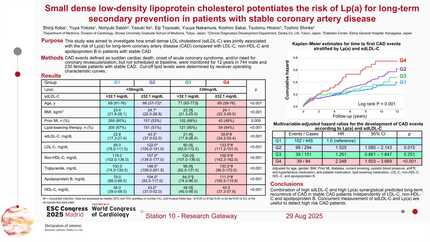
Recently it has been shown that not all lipid risk for atherosclerosis is due to LDL cholesterol. Both remnant particles and small and dense LDL (LDLpd) have been associated with a higer risk of the first cardiovascular events and recurrences.
We analyzed the lipid profile at admission of patients undergoing a cardiac rehabilitation (CR) program in a tertiary referral hospital, in association with other analytical parameters, clinical characteristics and outcomes of CR in these patients. We collected data from patients who completed the programme between January 2022 and March 2023 on admission and at the end of the programme. Clinical and anthropometric data and the results of the stress tests were collected. We defined a TG/HDL ratio greater than 2 as being associated with the presence of small and dense LDL.
170 patients who had complete analytical profiles at hospital admission were included, 80.5% were male with a mean age 57.9+/-9 years, 92.5% were referred after an acute coronary syndrome, 25.6% were diabetic, 56.6% were smokers and 37.7% were obese.
LDLpd at hospital admission was present in 73.4% of the patients. Male gender was more likely (86.3 vs. 68.9%, p=0.01, p=0.01) as well as being obese (83.9 vs 68.8%, p=0.04). No differences were found in terms of age, presence of DM, smoking or peripheral arterial disease. Nor did functional capacity or baseline quality of life. Less improvement was found in the SF 36 questionnaire (-6 vs +20, p=0.011), but similar in ergometry.
Basal lipid profile was associated with higher total Ch values (173 vs 149, p=0.002), Ch LDL (104 vs 79, p=0.000), remnants (32 vs 14, p=0.000). As for baseline LDL, 51.6% with LDLpd,had it high LDL Ch>100 mg/dl, compared to 22.2% of those without LDLpd (P=0.002).
As for the profile at discharge, we found that 63.5% still had LDLpd at discharge from the CR program ( vs. 15.9% of those without elevated LDLpd, P=0.000) and 22% had elevated remnants (P=0.002).
After CR, these patients still had higher TG values (128 vs 81, p=0.000), lower HDL-C (44 vs 56, p=0.003) and higher remnants (24 vs 17, p=0.000) despite the fact that a greater decrease in remnants and TG/HDL in this group.
More than one third of the patients who undergo a Cardiac Rehabilitation Program in our centre have LDLpd. Initially, male and obese patients have higher LDL and remnants. A weaker effect of the CR program in improving the lipidic profile has been observed in those patients. Consideration should be given to enhance lipid-lowering and intensive weight-loss treatments to decrease cardiovascular risk in this population.
Contributors



You may be interested in