Machine learning with electrocardiograms to optimize mortality risk stratification in patients with suspected acute coronary syndrome
European Heart Journal - Acute CardioVascular Care


Abstract
Type of funding sources: Public grant(s) – National budget only. Main funding source(s): National Heart, Lung, and Blood Institute (NHLBI) and National Center for Advancing Translational Sciences (NCATS).
The importance of risk stratification in patients with suspected acute coronary syndrome (ACS) extends beyond diagnosis and immediate treatment. It influences the precision of care delivery and the allocation of resources to those at highest risk of adverse events.
We sought to evaluate the prognostic value of electrocardiogram (ECG) feature-based machine learning models to risk-stratify long-term mortality in those with suspected ACS.
This was a multicenter prospective observational cohort study of consecutive, non-traumatic patients evaluated at the emergency department for suspected ACS. The derivation cohort included 4,015 patients from a University Medical Center (age 59±16 years, 47% women, 80% training with 10-fold cross-validation and 20% testing). Ascertainment of all-cause death was based on numerous data sources, including the Centers for Disease Control and Prevention’s National Death Index registry. We trained six machine learning methods for survival analysis using 73 morphological ECG features from presenting prehospital 10-second 12-lead ECGs. We used predicted risk scores in a variational Bayesian Gaussian mixture model to define three risk groups corresponding to low, moderate, and high-risk and compared the resulting classification performance against the HEART score. The external testing cohort included 3,095 patients from a University (age 59±15 years, 44% women).
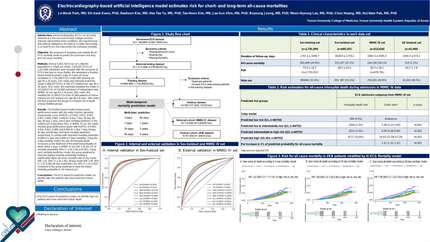
The mortality rate was 20.3% in the derivation cohort after an average follow-up period of 3.53 years (IQR 1.75 - 5.32). Extra Survival Trees outperformed other forecasting models during cross-validation. In the internal testing cohort, the derived risk groups were significantly predictive of survival (Kaplan-Meier log-rank test statistic = 121.14, p<0.001), outperforming the classification performance using the HEART score (Figure 1). Our machine learning-based risk stratification model detected >90% of death events missed by low-risk HEART score (Figure 2). Ruling-out the low-risk group, it achieved a negative predictive value of 93.4% with a sensitivity of 85.9% (compared to 89.0% and 75.0%, respectively, for the HEART score). This classification performance generalized well to our external testing cohort. Compared to those in the low-risk group, patients at moderate (OR = 3.62 [1.35-9.74]) and high (OR = 6.12 [2.38-15.75]) risk had significantly higher odds of 30-day cardiovascular death (n=109, 3.5%).
Using only features from the 10-second 12-lead ECG, we derived and externally validated a machine learning model that stratifies the mortality risk of patients during long-term follow up. This model outperformed current standard of care based on the HEART score. Future work should validate the potential of this decision-support tool in influencing treatment plans and resource allocation. Clustering performance Sankey diagram
Contributors

E Sejdic
Author
C Martin-Gill
Author
Z Faramand
Author
M Alrawashdeh
Author
T A Gokhale
Author
N T Riek
Author
R E Gregg
Author
J Zegre-Hemsey
Author
M Akcakaya
Author
S Saba
Author
C W Callaway
Author

You may be interested in