Clinical impact of sarcopenia on long-term mortality in patients undergoing coronary bypass grafting
European Heart Journal - Acute CardioVascular Care


Abstract
None.
Sarcopenia is an aging-related condition characterized by loss of skeletal muscle mass and is an indicator of subclinical atherosclerosis. The relationship between sarcopenia and long-term clinical outcomes in patients with advanced coronary artery disease who have undergone coronary artery bypass grafting (CABG) is not fully understood. We evaluated the prognostic implications of sarcopenia in patients undergoing CABG.
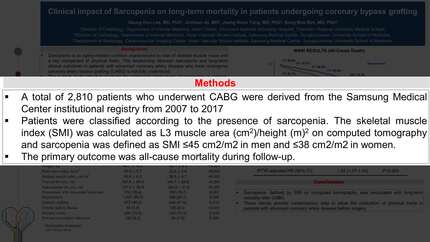
A total of 2,810 patients who underwent CABG was analyzed and classified according to presence of sarcopenia. The skeletal muscle index (SMI) was calculated as L3 muscle area (cm2)/height (m)2 on computed tomography. Sarcopenia was defined as SMI ≤45 cm2/m2 in men and ≤38 cm2/m2 in women. The primary outcome was all-cause mortality during follow-up. The median follow-up was 8.7 years, and 924 patients (32.9%) had sarcopenia. Patients with sarcopenia were older and more frequently women. SMI was significantly correlated with age (R=-0.34, P<0.001), weight (R=-0.56, P<0.001), and body mass index (R=-0.52, P<0.001). SMI was significantly associated with risk of death on a restricted cubic spline curve (HR=1.04 per-1 decrease, 95% CI 1.03-1.05, P<0.001). Patients with sarcopenia had a higher incidence of long-term mortality than those without sarcopenia (survival rate 41.4% vs. 62.8%; adjusted HR=1.18, 95% CI 1.03-1.36, P=0.02). Subgroup analysis showed that the prognostic implication of sarcopenia on long-term survival was more evident in men (adjusted HR=2.01, 95% CI 1.72-2.35) than women (adjusted HR=1.28, 95% CI 0.98-1.68) (interaction P=0.006).
Sarcopenia, defined by SMI on computed tomography, was associated with long-term mortality after CABG.




You may be interested in