No-touch vein grafts in coronary artery bypass surgery: a registry-based randomized clinical trial
European Heart Journal


Abstract
No-touch saphenous vein harvesting may enhance graft patency and improve clinical outcomes after coronary artery bypass grafting (CABG).
In this registry-based, randomized trial, patients undergoing CABG were randomly assigned to no-touch or conventional harvesting. The primary composite outcome was the proportion of patients with occluded/stenosed >50% vein graft on coronary computed tomography angiography, or who underwent percutaneous coronary intervention to a vein graft, or died. Secondary outcomes included clinical outcomes and leg wound complications.
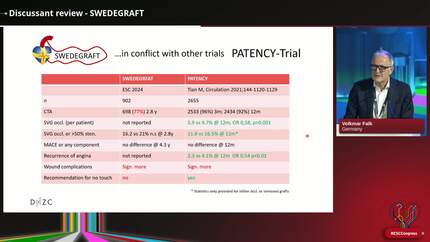
A total of 902 patients were enrolled with a mean total number of distal vein anastomoses of 2.0 (SD 0.87). The primary endpoint occurred in 90/454 (19.8%) of patients randomized to no-touch and in 107/446 (24.0%) of patients randomized to the conventional technique [difference, −4.3 percentage points; 95% confidence interval (CI) −10.1–1.6;
No-touch vein graft harvesting for CABG was not superior to conventional open harvesting in reducing vein graft failure or clinical events after CABG but increased leg wound complications. The primary outcome requires cautious interpretation due to a lower-than-expected number of primary events.
Contributors

Stefan Thelin
Author
Ivy Susanne Modrau
Author
Olov Duvernoy
Author
Magnus Dalén
Author
Mats Dreifaldt
Author
Anders Ericsson
Author
Örjan Friberg
Author
Anders Holmgren
Author
Per Hostrup Nielsen
Author
Henrik Hultkvist
Author
Karin Jensevik Eriksson
Author
Anders Jeppsson
Author
Mats Lidén
Author
Shahab Nozohoor
Author
Sigurdur Ragnarsson
Author
Ulrik Sartipy
Author
Lisa Ternström
Author
Raquel Themudo
Author
Per Vikholm
Author

You may be interested in