Role of bispectral index monitoring in the management of comatose patients after resuscitation from cardiac arrest
European Heart Journal - Acute CardioVascular Care


Abstract
In our cardiac intensive care unit we have recently introduced the bispectral index (BIS) monitoring in the management of comatose patients after resuscitation from cardiac arrest. This tool analyzes the electroencephalographic signal detected by a set of electrodes applied on the forehead of the patient and displays a simplified electroencephalographic trace, a spectroscopic trace, related to the type of brain activity, and a number, related to the sedation depth.
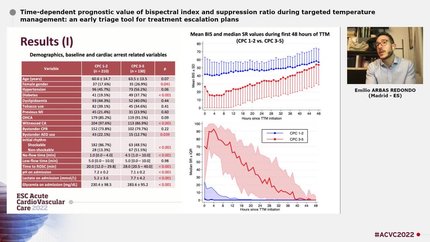
Our hypothesis is that the use of bispectral index monitoring may provide useful elements both for the early recognition of status epilepticus in comatose and sedated patients and for the definition of the neurological prognosis, especially in patients who show extremely reduced brain activity.
We retrospectively collected data from a consecutive series of comatose patients admitted to our cardiac intensive care unit after resuscitation from cardiac arrest from January 2023 to August 2024; patients who died within 6 hours of arrival and those for whom bispectral index monitoring data were not available were excluded. For all patients, the mean value of the bispectral index (BIS) during the first day and the presence of abnormalities suspicious for cerebral epileptic activity on the simplified electroencephalographic trace were evaluated. For all patients, the cerebral outcome defined as CPC (cerebral performance category) was evaluated at 30 days.
Of 15 comatose patients admitted to our unit after a cardiac arrest, neurological outcome was favorable with CPC 1-2 in 5 patients (33%) while 10 patients (67%) evolved towards an unfavorable neurological outcome with CPC 3-4-5. The mean BIS value during sedation in the first 24 hours of hospitalization was 41 in patients who had a good neurological outcome and 15 in patients with a poor neurological outcome, respectively; the drugs used for sedation in the two groups were the same (morphine, propofol). In 5 patients (33%) there was suspicion of cerebral epileptic activity on the BIS electroencephalographic trace, confirmed in all cases by standard electroencephalogram.
Post cardiac arrest syndrome is a very complex condition, and the post-anoxic brain injury is certainly one of the most important aspects in the definition of the prognosis of the patient. Although the experience in the use of bispectral index monitoring in these patients is limited, it could be useful for the early recognition and treatment of status epilepticus and it could play a promising role in the multiparametric approach for the neuroprognostication.
Contributors


You may be interested in