Carotid plaque score is associated with 10-year major adverse cardiovascular events in low–intermediate risk patients referred to a general cardiology community clinic
European Heart Journal - Cardiovascular Imaging


Abstract
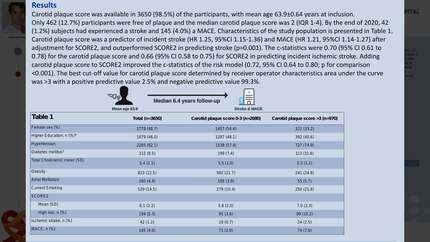
Atherosclerotic carotid plaque assessments have not been integrated into routine clinical practice due to the time-consuming nature of both imaging and measurements. Plaque score, Rotterdam method, is simple, quick, and only requires 4–6 B-mode ultrasound images. The aim was to assess the benefit of plaque score in a community cardiology clinic to identify patients at risk for major adverse cardiovascular events (MACE).
Patients ≥ 40 years presenting for risk assessment were given a carotid ultrasound. Exclusions included a history of vascular disease or MACE and being >75 years. Kaplan–Meier curves and hazard ratios were performed. The left and right common carotid artery (CCA), bulb, and internal carotid artery were given 1 point per segment if plaque was present (plaque scores 0–6). Administrative data holdings at ICES were used for 10-year event follow-up. Of 8472 patients, 60% were females (
A plaque score ≥ 2 can re-stratify low–intermediate risk patients to a higher risk for events. Plaque score may be used as a quick assessment in a cardiology office to guide treatment management of patients.
Contributors

Murray F Matangi
Author
Marie-France Hétu
Author
David W J Armstrong
Author
Jonas Shellenberger
Author
Daniel Brouillard
Author
Josh Baker
Author
Ana Johnson
Author
Nicholas Grubic
Author
Hannah Willms
Author
You may be interested in