Wearable device-measured moderate to vigorous physical activity and risk of degenerative aortic valve stenosis
European Heart Journal


Abstract
Physical activity has proven effective in preventing atherosclerotic cardiovascular disease, but its role in preventing degenerative valvular heart disease (VHD) remains uncertain. This study aimed to explore the dose–response association between moderate to vigorous physical activity (MVPA) volume and the risk of degenerative VHD among middle-aged adults.
A full week of accelerometer-derived MVPA data from 87 248 UK Biobank participants (median age 63.3, female: 56.9%) between 2013 and 2015 were used for primary analysis. Questionnaire-derived MVPA data from 361 681 UK Biobank participants (median age 57.7, female: 52.7%) between 2006 and 2010 were used for secondary analysis. The primary outcome was the diagnosis of incident degenerative VHD, including aortic valve stenosis (AS), aortic valve regurgitation (AR), and mitral valve regurgitation (MR). The secondary outcome was VHD-related intervention or mortality.
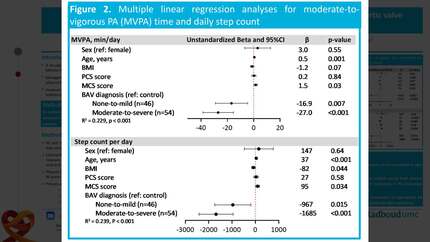
In the accelerometer-derived MVPA cohort, 555 incident AS, 201 incident AR, and 655 incident MR occurred during a median follow-up of 8.11 years. Increased MVPA volume showed a steady decline in AS risk and subsequent AS-related intervention or mortality risk, levelling off beyond approximately 300 min/week. In contrast, its association with AR or MR incidence was less apparent. The adjusted rates of AS incidence (95% confidence interval) across MVPA quartiles (Q1–Q4) were 11.60 (10.20, 13.20), 7.82 (6.63, 9.23), 5.74 (4.67, 7.08), and 5.91 (4.73, 7.39) per 10 000 person-years. The corresponding adjusted rates of AS-related intervention or mortality were 4.37 (3.52, 5.43), 2.81 (2.13, 3.71), 1.93 (1.36, 2.75), and 2.14 (1.50, 3.06) per 10 000 person-years, respectively. Aortic valve stenosis risk reduction was also observed with questionnaire-based MVPA data [adjusted absolute difference Q4 vs. Q1: AS incidence, −1.41 (−.67, −2.14) per 10 000 person-years; AS-related intervention or mortality, −.38 (−.04, −.88) per 10 000 person-years]. The beneficial association remained consistent in high-risk populations for AS, including patients with hypertension, obesity, dyslipidaemia, and chronic kidney disease.
Higher MVPA volume was associated with a lower risk of developing AS and subsequent AS-related intervention or mortality. Future research needs to validate these findings in diverse populations with longer durations and repeated periods of activity monitoring.
Contributors

Ziang Li
Author
Sijing Cheng
Author
Bo Guo
Author
Lu Ding
Author
Yu Liang
Author
Yinghan Shen
Author
Jinyue Li
Author
Yiqing Hu
Author
Tianxin Long
Author
Xinli Guo
Author
Junbo Ge
Author
Runlin Gao
Author
Philippe Pibarot
Author
Bin Zhang
Author
Haiyan Xu
Author

Yongjian Wu
Author
You may be interested in