Explainable machine learning for estimation of elevated left ventricular filling pressure: development and validation using multicenter data
European Heart Journal - Cardiovascular Imaging


Abstract
Guideline-recommended algorithms (GL-algorithm) (1) often results in indeterminate left ventricular filling pressure (LVFP) (2). Despite high accuracy, machine learning (ML) methods lack interpretability, limiting their clinical use.
To develop an explainable ML model for LVFP estimation, which provides patient-level interpretation.
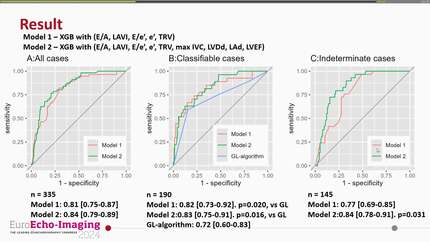
We retrospectively enrolled patients who underwent echocardiography and right heart catheterization at three hospitals within a median of 3 days. Two extreme gradient boosting (XGBoost) models were trained using data from two hospitals to estimate elevated pulmonary artery wedge pressure (PAWP >18 mmHg) as a surrogate for elevated LVFP. Model 1 used variables from GL-algorithm, while model 2 used variables selected by Shapley additive explanations (SHAP) values. Model performances were compared using external test data from the other hospital.
In a cohort of 956 patients (mean age 68±14 years; 43.2% female; 44.6% with left ventricular ejection fraction ≤50%), 296 (31.0%) had elevated PAWP. The GL-algorithm classified 42.5% as indeterminate LVFP, with 34.1% of these having elevated PAWP. The algorithm's area under the receiver-operating-characteristics curve (AUROC) was 0.72 (95% CI 0.60–0.83) for elevated LVFP. ML models classified all patients, with Model 1 achieving an AUROC of 0.81 (95% CI 0.75–0.87, p=0.020 vs. GL-algorithm) and Model 2 achieving an AUROC of 0.84 (95% CI 0.79–0.89, p=0.016). Notably, the ML models performed equally well regardless of GL-algorithm classification. SHAP force plots enabled patient-level interpretation. The model is available online.
Explainable ML outperformed the GL-algorithm in estimating LVFP, providing patient-level interpretability and potentially more user-friendly tools for clinicians.
Contributors



You may be interested in