Percutaneous edge-to-edge mitral valve repair in patients with complex mitral valve anatomy: mid- to long-term results in a tertiary referral university hospital.
European Heart Journal - Cardiovascular Imaging


Abstract
Transcatheter edge-to-edge repair (TEER) has proven to be an effective therapeutic alternative for certain cases of mitral regurgitation (MR) in patients who are not surgical candidates. Accumulated experience and technological advances allow TEER in selected patients with complex mitral valve anatomy who might initially be considered non-candidates for percutaneous treatment. Our main objective was to analyse the mid-to long-term characteristics and prognosis in patients with complex mitral valve anatomy treated with this technique compared to those with non-complex mitral anatomy.
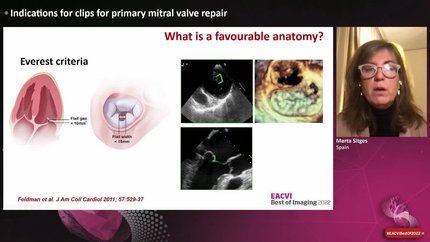
An observational study was conducted on a prospective cohort of patients from a tertiary referral hospital, which included all cases of severe MR treated using TEER from November 2011 to January 2024. Two groups of patients were compared: those with complex valve anatomy (CVA) versus those who did not present it (NCVA). Mitral valve complexity was defined as the presence of mitral cleft, calcification in the grasping zone, mitral valve area (MVA) ≤3cm2 , mobile posterior leaflet length <7mm, rheumatic leaflet thickening or presence of Barlow syndrome. Clinical, analytical and echocardiographic variables were analysed at baseline and during follow-up. Baseline characteristics and event-free survival, defined as death or hospitalisation for heart failure (HF) during follow-up, were compared between the CVA and NCVA groups using Kaplan-Meier curves.
A total of 191 patients were analysed (67% male, median age 74 (64-80) years), of whom 53 cases had complex valve anatomy. Among these, 7 cases presented with a mitral cleft, 2 cases had calcification in grasping zone, 3 cases had MVA≤3cm2, 35 cases with a mobile posterior leaflet length <7mm, 3 cases with rheumatic leaflet thickening and 8 cases had Barlow syndrome. Baseline clinical characteristics of both groups showed no significant differences, though there was a higher prevalence of hypertension in the CVA group, as shown in table 1. Most patients were in NYHA III-IV (62.3% CVA vs 72.4% NCVA, p=0.40) with a high percentage of prior hospitalization for HF in both groups without significant differences. The most common etiology of MR was functional with no differences between groups (CVA 77.4% vs NCVA 78.2%, p=0.43). With a median follow-up of 24 [9-50] months, event-free survival for readmission due to HF or all-cause mortality was 67% in CVA group, versus 64% in NCVA group, with no significant differences in median survival between them (p=0.41) (Figure 1).
In patients with MR and complex mitral valve anatomy who were initially not candidates for surgical or percutaneous treatment, a high event-free survival from death or readmission due to HF was achieved in the medium to long term. In centres with accumulated experience, TEER represents an effective therapeutic tool even in cases with complex anatomy, with no differences compared to those with more favourable anatomy.
Baseline clinical characteristics.
Kaplan-Meier curves
Contributors

M Ortiz Ruiz
Author
M Delgado Ortega
Author
R Gonzalez Manzanares
Author
S Ojeda Pineda
Author
J Suarez De Lezo
Author
M Alvarado Ruiz
Author
A Moran Salinas
Author
M Pan Alvarez-Osorio
Author
D Mesa Rubio
Author
You may be interested in