Predictors of residual right/left shunt in patients undergoing percutaneous transcatheter patent foramen ovale closure; a new clue "inferior vena cava-patent foramen ovale angle"
European Heart Journal - Cardiovascular Imaging


Abstract
Many different devices are currently used for percutaneous patent foramen ovale (PFO) closure (pPFOc). Current data for appropriate device selection are insufficient and confusing. The question of which device to choose during pPFOc is frequently posed by interventional cardiologist to echocardiographer, and it is a challenging question. The correct answer to this question is achieved by obtaining adequate anatomical occlusion.
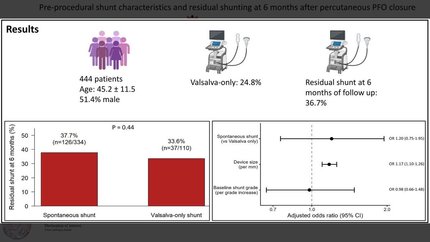
We aimed to determine the baseline anatomical predictors of PFO with residual right-to-left shunt (RLS) after pPFOc using transesophageal echocardiography (TEE).
Between May 2020 and May 2023, 103 patients who pPFOc for cryptogenic stroke were analysed. Patients were divided into two groups based on significant RLS. The presence of residual shunt was evaluated using contract echocardiography with bubble test at rest and during the Valsalva maneuver at 1, 6, and 12 months post-procedure. RLS were classified as follows: negative shunt (no bubble passage), mild shunt (1-9 bubbles), moderate shunt (10-20 bubbles), and severe shunt (>20 bubbles). At 12 months, patients with moderate and severe shunts were considered significant RLS [RLS (+)]. The implanted devices were also classified into three groups: Group 1 was used 23/25 mm OCCLUTECH devices, Group 2 was used 18x18 mm AMPLATZER devices, and Group 3 was used 27x30 mm OCCLUTECH and 30x30 AMPLATZER devices. Pre-procedural TEE was performed as part of our central protocol and anatomical features of PFO was evaluated (Figure-1). Logistic regression analysis was performed to assess predictors of post procedural RLS development.
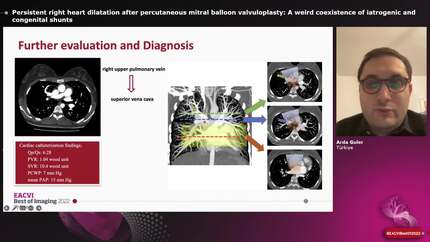
The procedure was successfully completed in all patients. In 21% of study population significant RLS was determined. During a median follow-up of 18 months, a patient died at 25th month due to metastatic testicular tumor, recurrent ischemic events were observed in 5 (5%) patients, and atrial fibrillation was detected in 3 (3%) patients. No significant difference was observed in the baseline clinical characteristics and laboratory parameters among of the patients. In addition to atrial septal aneurysm (ASA), aortic rim, tunnel width and length; IVC-PFO tunnel angle predicted RLS with a cut-off 11.3 (AUC:0.786, 64% sensitivity, 87% specificity) (Table-2, Figure-2). In individuals with significant RLS, longer and wider tunnel, shorter aortic rim, narrower inferior vena cava (IVC)-PFO tunnle angle and decreased tunnel length-left disc ratio were observed (Table- 1). IVC-PFO tunnel angle’s association with significant RLS was assessed individually with each conventional echo parameter (Figure- 3, Table -3).
IVC-PFO tunnel angle is a novel parameter and provides benefit to detect significant RLS in pPFOc patients.
and Figure 3
1,2,3 and Figure 2
Contributors


B E N A Y Ozbay
Author
Upmc University Of Pittsburgh Medical Center Pittsburgh , United States of America

S E V I L Tugrul Yavuz
Author
You may be interested in