Advanced mechanical analysis in STEMI in the pharmacoinvasive strategy era
European Heart Journal - Cardiovascular Imaging


Abstract
Global Longitudinal Strain (GLS) and left ventricular-arterial coupling (VAC), calculated as the ratio between arterial elastance (Ea) and left ventricular end-systolic elastance (Ees), are part of modern non-invasive indices of left ventricular (LV) and arterial system function. Their interaction in determining prognosis in post-STEMI patients with acute coronary syndrome (ACS) is not well established, particularly in relation to reperfusion strategies.
It aims to demonstrate through multiple mechanisms (and advanced mechanics analysis) that gaining reperfusion time has clinical benefits, and once again, pharmacoinvasive strategy (PhI) proves it is not inferior than percutaneous coronary intervention (PCI).
Echocardiography was performed on 144 post-STEMI patients who were followed up for 750 days after hospitalization. Each baseline characteristic variable was analyzed using Wilcoxon and Shapiro-Wilk tests. Kaplan-Meier methods with log-rank tests were employed to assess the presence of MACE (including heart failure, cardiogenic shock and death) in two main variables across four groups. The first compared VAC within the parameter range of 0.95-1.1 and reperfusion strategy (PhI vs PCI), while the second analyzed GLS <-18 and reperfusion strategy (PhI vs PCI).
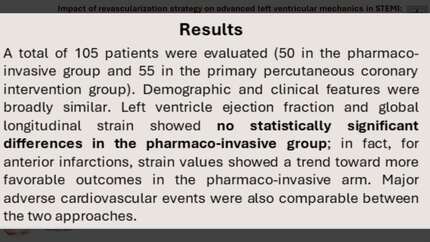
We included 144 patients, with 87% (n=125) being male, and a median age of 60 years. The most common comorbidities were hypertension (52%) and type 2 diabetes (40.3%). In our initial comparison between VAC and reperfusion strategy, Kaplan-Meier curves demonstrated significant differences in the presence of major adverse cardiovascular events (MACE) between VAC and the reperfusion strategy. There was a better prognosis observed in both PhI groups, particularly in the VAC 0.95-1.1 group (p-value < 0.032). Conversely, the group with the highest number of events included those with VAC outside the 0.95-1.1 range and PCI strategy. Furthermore, in the GLS analysis, the PhI-based reperfusion strategy yielded superior results in terms of MACE outcomes (p-value <0.041). Nonetheless, GLS remained significant with a value of <-18 for predicting the presence of MACE
Both GLS and VAC, as advanced mechanical analyses, serve as affordable predictors of MACE in post-STEMI patients. More importantly, our findings demonstrate that pharmacoinvasive therapy (PhI) offers superior prognosis for our patients. Therefore, prioritising early reperfusion treatment, whether pharmacoinvasive or primary, is imperative.
GLS and reperfusion strategy
VAC and reperfusion strategy
Contributors

M Garcia Villarejo
Author
Instituto Nacional de Cardiologia Ignacio Chavez Ciudad de Mexico , Mexico

X Latapi Ruiz Esparza
Author

J Cuellar Vargas
Author
D Araiza Garaygordobyl
Author
R Gopar Nieto
Author
R Neri Bale
Author
M A Arias Mendoza
Author
You may be interested in