Exploring the inter-vendor variability of GLS: a myocardial deformation analysis on a cohort of healthy volunteers.
European Heart Journal - Cardiovascular Imaging


Abstract
Global longitudinal strain (GLS) by Speckle-tracking Echocardiography (STE) has emerged as the most sensitive marker of myocardial function with a prognostic value in many cardiac diseases. GLS could also be calculated by cardiac magnetic resonance (CMR) which is the gold standard method for LV morph functional evaluation, applying the feature-tracking (FT) technique. However, there are still difficulties related to the lack of interchangeability between STE and FT techniques and the inter-vendor variability of myocardial deformation parameters.
To assess the variability of transmural GLS measurements using different analysis software packages from three different specific vendors (Echo 1-2-3) and to compare the variability of endocardial GLS measurements using an independent vendor software between cine-loops obtained by three different echo machines and CMR.
We enrolled 50 healthy volunteers (age 29 ± 3 years, males 60%, BSA 1.7±0.2 m2) without cardiovascular risk factors. All the subjects were in sinus rhythm (HR 69 ± 12 bpm) and had a good acoustic window. Each volunteer underwent an echocardiographic study on three different echo machines on the same day (Echo 1, Echo 2, Echo3). Over the course of a week, 11 patients also underwent a CRM without contrast administration. The images were acquired on each echo machine by an expert operator. All transmural GLS measurements were performed by a single observer using the dedicated post-processing software package of the respective vendor that were based on a semi-automatic method with possible manual adjustments by the operator. The same operator analyzed the cine-loops obtained from the three echo machines and CMR with an independent software which performed the analysis of STE/FT parameters with a semi-automatic method. The following parameters were obtained: left ventricular (LV) Circumferential Global Strain (GCS), GLS, EF, end-diastolic volume (EDV) and end-systolic volume (ESV).
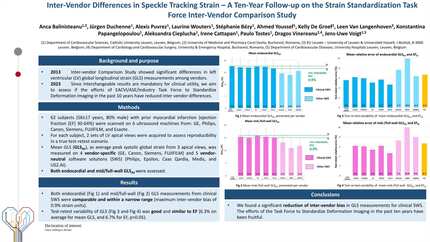
Comparing the parameters obtained by the three specific software vendors of the echo machines, there were no statistically significant differences in transmural GLS values (p=0.313); (Picture 1). Comparing the parameters obtained by an independent software vendor, there were no statistically significant differences between the endocardial GLS, GCS and EF computed by the software (respectively p=0.290, p=0.655 and p=0.51; (Table 1).
In clinical practice, transmural GLS do not differ using specific vendor software of different echo machines on a cohort of healthy volunteers. At the same time, endocardial GLS, GCS and EF values calculated by an independent multivendor software using echo cine-loops of three different echo machines do not differ between them and from CMR-FT obtained GLS and GCS values.
Picture 1
Contributors


A Ciuffreda
Author

L Netti
Author
V Paladino
Author
G Rubino
Author
D Angotti
Author
L Marchitelli
Author
S Cimino
Author

V Maestrini
Author
You may be interested in