Myocardial mechanics and outcomes after transcatheter aortic valve replacement. Does strain rate have added prognostic value?
European Heart Journal - Cardiovascular Imaging


Abstract
Transcatheter aortic valve implantation (TAVI) has firmly become treatment option for elderly and/or high-risk patients with severe symptomatic aortic stenosis. Studies have shown that TAVI induces improvement in left ventricular (LV) systolic function, quantified using global longitudinal strain (GLS).
To test if improvement in longitudinal deformation post TAVI is associated with changes in strain rate – the only non-invasive echo parameter associated with myocardial contractility. We wanted to assess impact of changes in longitudinal deformation and strain rate (SR) on clinical outcomes.
We studied retrospectively all consecutive patients who underwent TAVI in our Valve specialist center from 1st April 2023 to 31st March 2024. All participants underwent a transthoracic echocardiogram before and within 3 months following TAVI. We have re-measured mean trans-valvar pressure gradients and performed offline speckle tracking analysis using dedicated software (TomTec and GE EchoPAC) before and after TAVI. Data on all-cause mortality and cardiac hospitalizations were obtained from electronic medical records.
Overall, 305 patients (mean age of 81±7.7 years) with severe aortic stenosis underwent TAVI. 255/305 patients (83%) had a successful and uncomplicated TAVI procedure, 26 (8.5%) developed complete heart block requiring permanent pacemaker insertion during the index admission, 15 (4.9%) experienced vascular access complications (pseudoaneurysm, haematoma), 5 (1.6%) developed haemopericardium requiring drainage and 5 (1.6%) had TAVI-related stroke, all patients were discharged with routine F/U in place.
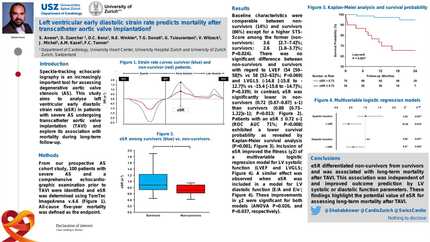
247 (81%) who had complete echocardiography data were included into analysis, 45% were female. Significant reduction in trans-valvar gradient was accompanied by significant improvement in LV myocardial and endocardial GLS and average LV strain rate post-TAVI. The mean follow-up period was 246±107 days. There were 8 cases contributing to all-cause mortality and 12 cardiac hospitalizations. There was a significant difference in SR between alive and deceased patients (0.94±0.3 vs. 0.70±0.2, P=0.026). Post TAVI strain rate (HR 45.6; 95% CI 1.67 to 124.6, P<0.05) was the only independent predictor of all-cause mortality.
TAVI produces significant early improvement in LV mechanics. LV strain rate is an important independent predictor of all-cause mortality post TAVI. The addition of LV SR during echocardiographic assessment may be of value for the early identification of TAVI patients who are at greatest risk and who may benefit from early intensified risk factor management.
KM CURVE: SR & ALL CAUSE MORTALITY
Contributors

K Kipourou
Author
Guy's and St Thomas' NHS Trust Foundation Trust London , United Kingdom of Great Britain & Northern Ireland

H Abdelhafiz
Author
A Barron
Author
V Panoulas
Author
J O'driscoll
Author
St George's University Hospital NHS Foundation Trust London , United Kingdom of Great Britain & Northern Ireland
M Jimeno
Author
B Meric
Author
S Rahman Haley
Author
Guy's and St Thomas' NHS Trust Foundation Trust London , United Kingdom of Great Britain & Northern Ireland
A Baltabaeva
Author
You may be interested in