Performance of computerized self-reported medical history taking and HEAR score for safe early rule-out of cardiac events in acute chest pain patients: the CLEOS-CPDS prospective cohort study
European Heart Journal - Digital Health


Abstract
A simplified version of the history, electrocardiogram, age, risk factors, troponin (HEART) score, excluding troponin, has been proposed to rule-out major adverse cardiac events (MACEs). Computerized history taking (CHT) provides a systematic and automated method to obtain information necessary to calculate the HEAR score. We aimed to evaluate the efficacy and diagnostic accuracy of CHT in calculating the HEAR score for predicting MACE.
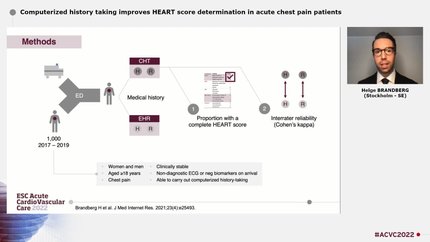
Prospective study including clinically stable adults presenting with chest pain at the emergency department (ED) of Danderyd University Hospital (Stockholm, Sweden), in 2017–19. Participants entered their medical histories on touchscreen tablets using CHT software. The HEAR and HEART scores were calculated from CHT data. Thirty-day MACE and acute coronary syndrome (ACS) outcomes were retrieved, and the diagnostic accuracy was assessed. Logistic regression was used to determine the most predictive components of the HEAR score. Among 1000 patients, HEART and HEAR scores could be calculated from CHT data in 648 and 666 cases, respectively, with negative predictive values [95% confidence interval (CI)] of 0.98 (0.97–0.99) and 0.99 (0.96–1.00). Two patients with HEAR score <2 experienced a 30-day MACE. The age [odds ratio (OR) 2.75, 95% CI 1.62–4.66] and history (OR 2.38, 95% CI 1.52–3.71) components of the HEAR score were most predictive of MACE. Acute coronary syndrome outcomes provided similar results.
The HEAR score acquired by CHT identifies very-low-risk patients with chest pain in the ED, safely ruling out ACS and MACE. This highlights the value of computerized history taking by patients, which may reduce unnecessary tests and hospital admissions.
Contributors




You may be interested in