Early discharge programme after transcatheter aortic valve implantation based on close follow-up supported by telemonitoring using artificial intelligence: the TeleTAVI study
European Heart Journal - Digital Health


Abstract
Evidence regarding the safety of early discharge following transcatheter aortic valve implantation (TAVI) is limited. The aim of this study was to evaluate the safety of very early (<24) and early discharge (24–48 h) as compared to standard discharge (>48 h), supported by the implementation of a voice-based virtual assistant using artificial intelligence (AI) and natural language processing.
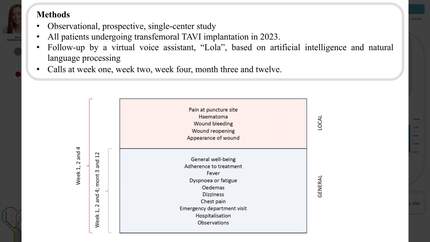
Single-arm prospective observational study that included consecutive patients who underwent TAVI in a tertiary hospital in 2023 and were discharged under an AI follow-up programme. Primary endpoint was a composite of death, pacemaker implantation, readmission for heart failure, stroke, acute myocardial infarction, major vascular complications, or major bleeding, at 30-day follow-up. A total of 274 patients were included. 110 (40.1%) patients were discharged very early (<24 h), 90 (32.9%) early (24–48 h), and 74 (27.0%) were discharged after 48 h. At 30-day follow-up, no significant differences were found among patients discharged very early, early, and those discharged after 48 h for the primary endpoint (very early 9.1% vs. early 11.1% vs. standard 9.5%;
Early and very early discharge in patients undergoing TAVI, supported by close follow-up using AI, were shown to be safe. Patients with early and very early discharge had similar 30-day event rates compared to those with longer hospital stays. The AI system contributed to the early detection and resolution of complications.
Contributors

Marta Herrero-Brocal
Author
Raquel Samper
Author
Jorge Riquelme
Author
Javier Pineda
Author
Pascual Bordes
Author
Fernando Torres-Mezcua
Author
José Valencia
Author
Francisco Torres-Saura
Author
María González Manso
Author
Raquel Ajo
Author
Juan Arenas
Author
Eloísa Feliu
Author
Juan Gabriel Martínez
Author
Juan Miguel Ruiz-Nodar
Author
You may be interested in