Machine learning approaches for risk prediction after percutaneous coronary intervention: a systematic review and meta-analysis
European Heart Journal - Digital Health


Abstract
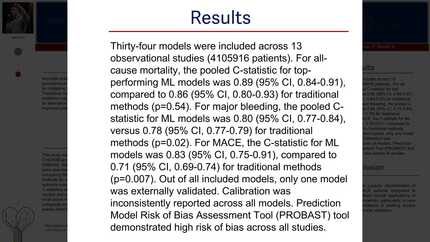
Accurate prediction of clinical outcomes following percutaneous coronary intervention (PCI) is essential for mitigating risk and peri-procedural planning. Traditional risk models have demonstrated a modest predictive value. Machine learning (ML) models offer an alternative risk stratification that may provide improved predictive accuracy.
This study was reported according to the Preferred Reporting Items for Systematic Reviews and Meta-Analyses, Critical Appraisal and Data Extraction for Systematic Reviews of Prediction Modelling Studies and Transparent Reporting of a multivariable prediction model for Individual Prognosis or Diagnosis guidelines. PubMed, EMBASE, Web of Science, and Cochrane databases were searched until 1 November 2023 for studies comparing ML models with traditional statistical methods for event prediction after PCI. The primary outcome was comparative discrimination measured by
Machine learning models marginally outperformed traditional risk scores in the discrimination of MACE and major bleeding following PCI. While integration of ML algorithms into electronic healthcare systems has been hypothesized to improve peri-procedural risk stratification, immediate implementation in the clinical setting remains uncertain. Further research is required to overcome methodological and validation limitations.
Contributors

Daud Mutahar
Author
James Gorcilov
Author
Aashray K Gupta
Author
Joshua G Kovoor
Author
Brandon Stretton
Author
Naim Mridha
Author
Gopal Sivagangabalan
Author
Aravinda Thiagalingam
Author
Clara K Chow
Author
Sarah Zaman
Author
Rohan Jayasinghe
Author
Pramesh Kovoor
Author
Stephen Bacchi
Author
You may be interested in