Reproducibility of cardiac computed tomography classifications of hypoattenuated thickening and peridevice leak following left atrial appendage closure
European Heart Journal - Cardiovascular Imaging


Abstract
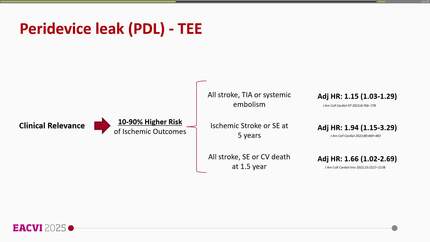
To assess the reproducibility of interpreting hypoattenuated thickening (HAT) and peridevice leak (PDL) using cardiac computed tomography (CT) imaging following Watchman FLX left atrial appendage closure (LAAC).
In this multicentre retrospective reproducibility study, 100 anonymized post-LAAC cardiac CT scans were evaluated within the same cardiac phase by an experienced and a novice rater blinded to prior evaluations. All scans were evaluated twice by each rater, assessing overall HAT and PDL categories as well as specific associated findings based on suggested algorithms for post-LAAC interpretation. Inter- and intra-rater agreement and reliability were evaluated using absolute agreement, Cohen’s kappa, and Kendall’s tau for categorical variables, and mean difference, Bland–Altman plots, limits of agreement (lower and upper), and intra-class correlation coefficients (ICCs) for continuous variables. Within overall categories of both HAT and PDL, substantial agreement (kappa ≥0.61) and reliability (Kendall’s tau-
Despite only minimal training of one rater, overall high levels of inter- and intra-rater agreement and reliability were observed across the chosen algorithms for interpretation of HAT and PDL following Watchman FLX LAAC. The prognostic implications of the included variables are to be explored in future trials and registries.
Contributors

Gerardo Lo Russo
Author
Hasan S Alarouri
Author
Jeremy D Collins
Author
Jesper Møller Jensen
Author
Jens Erik Nielsen-Kudsk
Author
Mohamad Alkhouli
Author
Kasper Korsholm
Author
You may be interested in